
This is the one week the entire Prosper roster is in the same room. Three days at The Wynn Las Vegas Resort – nine coaches, headline guests, live trading, and a floor full of traders leveling up together.

IT’S YOUR RIGHT
What a day, what a week! The market has been wrestling for months with the monetization of artificial intelligence (AI) versus the economics of the billions of dollars invested to get there. It’s been a tough match. The expectation from AI-related tech companies was to either solidify the AI spending story or keep investors questioning it. It looks like we might have an answer: The accountability needed to justify AI spending appears to be starting to come to roost.
US stocks tumbled on Friday, with the Nasdaq suffering its largest one-day percentage drop since June 5 following disappointing quarterly results from Intel and Amazon, which amplified growing worries surrounding AI-related companies’ massive spending on the nascent technology. This disappointment led investors to flock to other sectors. All three major indices lost value, but ended Friday’s session off intraday lows.
Third-quarter earnings season has passed the halfway mark, with 299 companies in the S&P 500 having reported. Of those, 82% have beaten consensus expectations, according to LSEG data. Analysts now expect third-quarter S&P 500 earnings growth of 31.6%, year-on-year, per LSEG.
And what awaits us this coming week? The highly anticipated midterm elections (more on that below), and another nonfarm payroll report. Be prepared for continued volatility.
For the week, the DOW lost -0.9 % to 51,770, the S&P 500 fell -0.6% to 7,580, the Nasdaq slumped -2% to 25,437 and the Russell 2000 gained +1.3% to 2,812. The CBOE VIX dipped -0.2% to 19.42.
Tech Wipeout
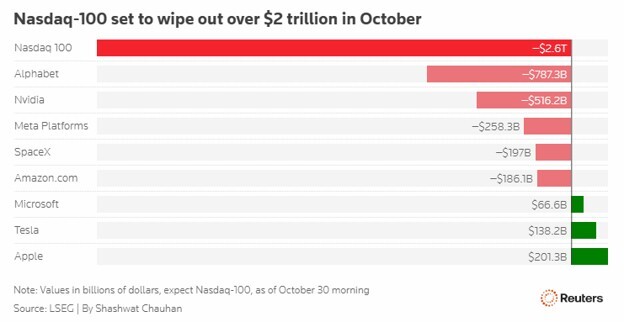
More than $2 trillion in market value was wiped from the tech-heavy Nasdaq 100 this month, as Big Tech earnings intensified investor scrutiny of whether the billions being poured into artificial intelligence can generate returns quickly enough.
Alphabet suffered its biggest one-day percentage drop on record on Thursday after disappointing results in the core business of search advertising and a massive acceleration in cash burn. Meta’s plans for a record $97.5 billion fund raise heightened concerns about shareholder dilution and whether mounting AI spending could force other Big Tech companies to increasingly tap capital markets. Microsoft is reportedly planning to raise abot $25 billion through its first US investment-grade bond sale in more than nine years. Morgan Stanley forecast capital spending on AI infrastructure overall will surpass a trillion dollars next year.
AI companies’ growing reliance on debt funding is emerging as a new risk for investors, challenging the view that the companies at the heart of the boom are insulated from macroeconomic pressures.
The concern is spreading beyond stocks to credit markets, where investors are starting to price in the possibility that rising financing costs, combined with slower returns on AI spending, could squeeze companies previously viewed as relatively insulated.
Revenue across the “Magnificent Seven” has remained strong since ChatGPT’s launch in 2022, showcasing insatiable demand and perhaps why investors were initially willing to back the spending, even as the timeline of payoffs remains uncertain.
Amazon’s cloud computing cash cow, Amazon Web Services, continued to accelerate, while Meta offered better-than-expected revenue growth and an upbeat outlook. Microsoft also forecast strong cloud growth in its latest earnings report.
Big Tech has historically spent heavily on infrastructure to build and expand businesses such as cloud computing, online advertising and e-commerce, but the AI boom has pushed capital expenditure to dizzying levels.
This year’s AI capex by Amazon, Alphabet, Meta, Oracle and Microsoft would likely equal their cumulative spend since the November 2022 launch of ChatGPT, J.P. Morgan analysts noted. J.P. Morgan expects global AI capex to reach $5.5 trillion by 2030, and sees $900 billion being spent in 2026 alone.

Does the Midterm Vote
Matter to the Markets?
The S&P 500 may be only a few percentage points shy of record territory, but a sharp pullback in semiconductors and other hot artificial-intelligence stocks have shaken up many investors.
The road ahead might not look all that promising, given the number of looming obstacles that could continue to test the market. Treasury yields remain near their highest levels in decades, even after a rally this week brought the 10-year yield back below 5%. The war in Iran is dragging on and crude oil prices are back up to levels we haven’t seen since May. META, GOOGL, AMZN and INTC reports and comments have the AI world on edge.
But better times likely lie ahead. A well-established historical pattern suggests that stocks will likely continue on higher — no matter who wins in November’s midterm elections. Since 1950, the S&P 500 has risen by an average of 15.5% between Election Day and June 30 of the following year.
The biggest U.S. companies have recently been growing earnings at a breakneck pace, and Wall Street expects results should continue to dazzle investors in 2027. And while past returns are no guarantee of future performance, the historical record looks solid.

Third year’s the charm
Next year brings the third year of the four-year presidential term cycle —historically, the market’s strongest period.
The fourth quarter of a midterm year has seen the second-strongest average performance of the 16 quarters that make up the four-year cycle. The best sector? The first quarter of year three, which is coming up next.
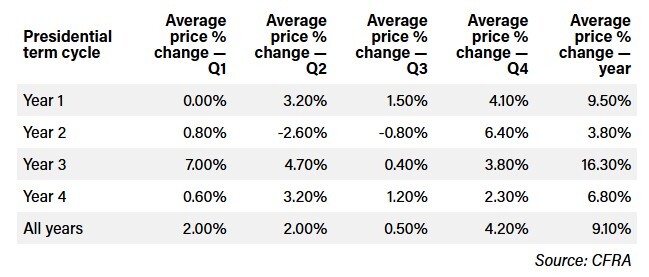
As the table above shows, stocks typically deliver strong returns during the fourth quarter, even outside of election years. The period has the strongest average return of any of the four calendar quarters, according to Sam Stovall’s numbers. Rather than being a statistical quirk, Stovall said he believes things have played out this way for a reason.
“The reason for this is the party in power wants to stay in power after the upcoming presidential elections,” Stovall said. “They start passive stimulative measures that will likely bear fruit by the time the person or the party is up for re-election.”
President Trump has already gotten a head start on that. With the help of Republicans in Congress, he delivered landmark tax cuts in 2025. While campaigning for the midterms, Trump said he would pay every American adult a $5,000 “dividend” if Republicans managed to hang on to the U.S. Senate and the House of Representatives.
Much of the recent stock-market pain has been centered around technology stocks. For the S&P 500 to deliver returns on par with its historical performance, tech stocks — which carry a weighting in the index of just under 40% — will likely need to participate.
“I haven’t worked out the exact mathematics, but it is highly improbable for the S&P 500 to put in a sizable gain without the participation of the largest tech companies,” said Steve Sosnick, chief strategist at Interactive Brokers.
Economic Reports of Note (All Times EST):
Monday
9:45 am – US: S&P Global Manufacturing PMI
10:00 am – US: ISM Manufacturing
10:00 am – US: Construction Spending
10:30 am – US: Atlanta Fed GDPNow
10:30 am – US: 3 & 6-month Bill Auctions
11:15 am – US: Fed Member Goolsbee Speaks
10:30 pm – AUS: Royal Bank of Australia Interest Rate Decision
Tuesday
8:55 am – US: Redbook
10:00 am – US: JOLTS
10:00 am – US: Factory Orders
10:00 am – US: Durables
2:00 pm – US: Total Vehicle Sales
Wednesday
5:00 am – EU: CPI
7:00 am – US: Mortgage Data
8:15 am – US: ADP Nonfarm Employment Change
8:30 am – US: Trade Balance
9:45 am – US: S&P Global Services PMI
10:00 am – US: ISM Non-Manufacturing PMI
10:30 am – US: Crude Oil Inventories
10:30 am – US: Atlanta Fed GDPNow
10:35 pm – JAP: 10-year JGB Auction
Thursday
5:00 am – EU: PPI
5:30 am – US: Challenger Job Cuts
7:00 am – UK: Bank of England Interest Rate Decision
8:30 am – US: Weekly Jobless Claims
9:15 am – EU: ECB Interest Rate Decision
9:10 am – US: FOMC Member Barkin Speaks
11:30 am – US: 4 & 8-week Bill Auctions
Friday
8:30 am – US: October Nonfarm Payrolls
10:00 am – US: Michigan Consumer Sentiment
10:00 am – US: Michigan Inflation Expectations
12:15 pm – US: FOMC Member Bowman Speaks