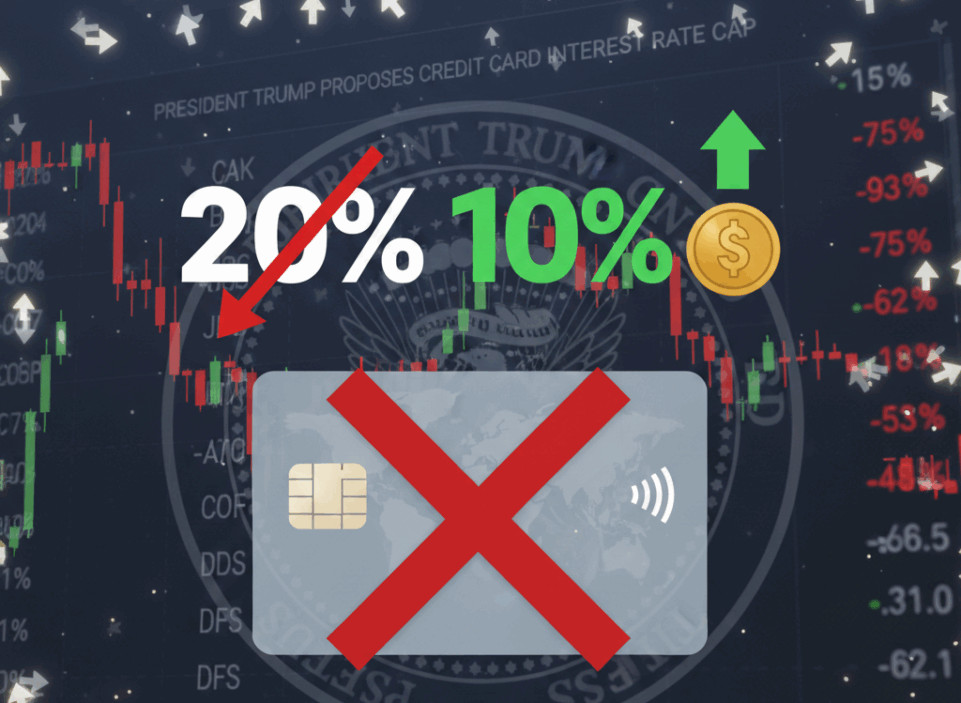
A high-profile policy debate has re-entered the financial spotlight surrounding credit card interest rate caps. Last week, President Donald Trump called for a temporary national cap on credit card interest rates. He proposed a maximum annual rate of 10% over a one-year period, starting January 20, 2026.
President Trump’s proposal would aim to combat the burden of high borrowing costs for consumers, who face average annual percentage rates (APRs) on credit cards around 20% (some more than 30%). The topic of credit card interest rate caps isn’t unfamiliar, and has been brought up in the past. As expected, President Trump’s recent proposal stoked controversy, garnering polarized reactions from lawmakers, financial institutions, and investors.
Details on President Trump’s Credit Card Interest Rate Proposal
On January 10, 2026, President Trump announced in a Truth Social post (and in public statements) that he wants credit card companies to cap interest charges at 10% for one year, saying it would be an effective way to ease financial pressure on American households. His proposed interest rate cap would mean that credit card companies could charge no more than 10% interest on credit card balances.
For those who might need clarification, here’s how credit card interest rates work:
The analysis, insights, and strategies shared by Prosper Trading Academy’s coaches in Prosper Insider are strictly for educational and informational purposes only. All content reflects the personal opinions of the coaches and should not be construed as specific investment advice or recommendations. Any examples discussed are illustrative in nature and do not represent actual live trade signals or instructions to buy or sell securities. Trading involves risk, and individuals should carefully evaluate their own financial situation before making investment decisions.
The amount of interest a credit card company charges a cardholder over a one-year period is called the annual percentage rate (APR). Let’s say you have a $5,000 balance on your credit card. With a 22% APR (roughly the current US average), you’d pay about $1,100 in interest over one year—if you only made minimum payments, and didn’t add new charges.
However, under a 10% APR, you would only pay about $500 in annual interest, saving $600.
Implementation of President Trump’s proposed credit card interest rate cap would require congressional approval, since federal authority to impose such policy is limited without new legislation. This is in addition to the legal hurdles such a law would face.
Supporters argue an interest rate cap could lower consumer borrowing costs by billions and provide short-term relief. Opponents of the proposition warn it could reduce credit availability, prompt banks to tighten underwriting standards, and push consumers toward unregulated, higher-cost credit alternatives.
A potential credit card interest rate cap could also profoundly affect the stock market. From sector rotation and shifting market sentiment, to heightened volatility and historical market trends, we’ll break down three potential scenarios traders could expect.
Financial and Bank Stocks Could Become Volatile

Bank and credit card issuer stocks reacted negatively immediately after President Trump’s proposal. Major lenders saw shares decline, as investors weighed the potential hit to net interest margins—a key profit driver for consumer lenders. This reflects concerns that credit card interest rate caps could compress profitability, and undermine earnings forecasts for these companies.
This shouldn’t come as a surprise.
Obviously, banks and credit card issuers would feel the most immediate and direct impacts of a credit card interest rate cap.
Why?
Because their profitability relies heavily on net interest margins.
Credit cards are among the highest-margin lending products. Like I mentioned earlier—APRs often exceed 20% (sometimes 30+%). A mandated interest rate cap of 10% would materially compress revenue, particularly for issuers with large revolving credit portfolios. In theory, credit card companies could see revenue streams coming from credit card interest decline over 60%.
When similar regulatory concerns surfaced in the past, stocks like Capital One (COF), Discover Financial Services (DFS), American Express (AXP), and large banks such as JPMorgan (JPM) and Citigroup (C) tended to underperform, as analysts revised earnings expectations lower.
For context, here’s how each of those stocks moved yesterday (Monday, January 12)
- COF: -6.42%
- DFS: -0.21%
- AXP: -4.27%
- JPM: -1.43%
- C: -2.98%
Moreover, regional banks and subprime-focused lenders would likely be hit hardest. This would be due to factors like thinner margins and higher default risk.
Speaking of volatile stocks, my go-to options trading system is specifically designed for those kinds of conditions. My Ultimate Guide to Options Essentials breaks down how it works in three straightforward steps. Check out this page to download your free copy of my guide.
Interest Rate Caps Could Cause Sector Rotation
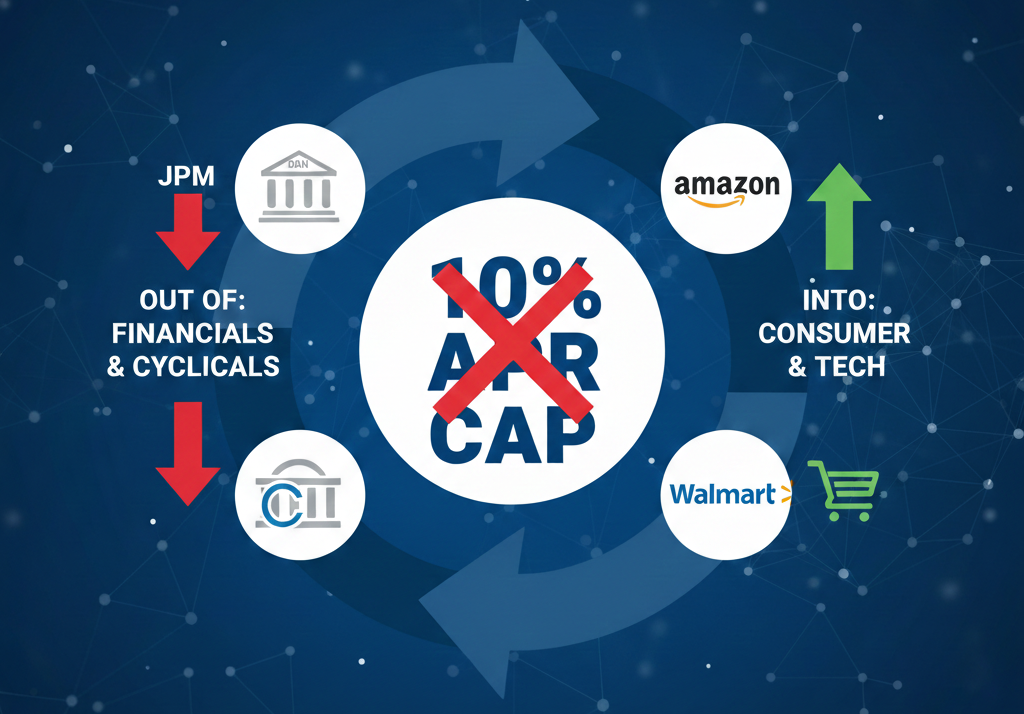
The heightened regulatory risk brought about by a credit card interest rate cap in traditional banking could push investors to reallocate capital toward sectors with less exposure. Fintech companies and alternative lenders that rely less on high-interest consumer credit could potentially benefit—especially if banks pull back on lending. Consumer payment platforms and personal loan providers could also see relative strength if demand shifts away from traditional credit cards.
If credit card companies wind up capping interest rates, here are some of the ways many of them could respond:
- Reduce credit limits
- Close accounts for riskier borrowers
- Put stringent standards in place for new applicants
- Hike other fees
- Reduce rewards and perks
- Exit certain segments entirely to maintain profitability
If such measures are taken, they could lead to slow consumer spending growth. Critics argue this would especially affect lower-income households that rely heavily on credit cards for discretionary purchases.
To bring this full circle—that dynamic would create a ripple effect across sectors. Consumer discretionary stocks, like retailers, travel companies, and e-commerce firms could see pressure if spending slows.
Names like Amazon (AMZN), Target (TGT), or Best Buy (BBY) often react to shifts in consumer credit availability.
At the same time, capital may rotate into companies with less exposure to consumer leverage, like utilities, healthcare, and defensive staples. Alternatively, fintech firms and payment processors that generate revenue from transaction volume rather than interest—like Visa (V) and Mastercard (MA)—could hold up better, relative to traditional lenders.
Broader Market Risk Sentiment Could Shift
Policy uncertainty around financial regulation tends to increase volatility. President Trump’s proposal for credit card interest rate caps is no exception. Even if a rate cap faces legislative hurdles, traders often price in the risk before outcomes are known.
This can elevate volatility—especially in interest-rate-sensitive, and highly regulated sectors. If investors begin factoring in the chance of stricter credit conditions, it could weigh on broader indices, particularly financials and cyclical sectors. Conversely, some consumer discretionary or retail stocks might benefit if lower interest burdens free up spending.
Some names that could fall under this category include:
- Amazon (AMZN)
- Target (TGT)
- Walmart (WMT)
- Home Depot (HD)
- Lowes (LOW)
Historically, regulatory headlines have led to short-term spikes in the VIX, uneven index performances, and increased options activity. The Dow Jones Industrial Average (DOW)—which has heavier exposure to financials—could lag the Nasdaq (IXIC), which is more tech-weighted, and less dependent on consumer lending margins.
In some scenarios, traders may view rate caps as mildly inflation-cooling or consumer-supportive, benefiting defensive growth names. In others, concerns about credit contraction could weigh on broader economic growth expectations.
Shifting market sentiment tends to cause market volatility. If you’re looking to prepare for these conditions, my Ultimate Guide to Options Essentials breaks down my 3-step M.A.P. System, which is designed for trading volatile conditions. You can get your free copy of my guide on this page.
The Bottom Line
President Trump’s proposed credit card interest rate cap has sparked intense debate across financial markets, consumer advocacy circles, and the banking industry. While the intent is to reduce borrowing costs for consumers, the financial sector’s reliance on interest income means it could have far-reaching consequences—from tighter credit conditions to stock market volatility.
Traders should consider watching for legislative developments, investor sentiment shifts in bank equities, and rotation into sectors positioned to potentially benefit—should credit flows tighten. Whether the proposal becomes law remains uncertain…but the market’s reaction demonstrates how policy talk alone can move stock prices and risk premiums.
If you’re worried which direction news of credit card interest rate caps could cause stocks could move, then it helps to have a plan in place. My Ultimate Guide to Options Essentials lays out what I call the 3-step M.A.P. System for trading options in volatile markets. You can get a free copy of my guide here if you’re interested.