
June 2, 2019

Eyes Are on the Fed, but What Is the Fed Watching?

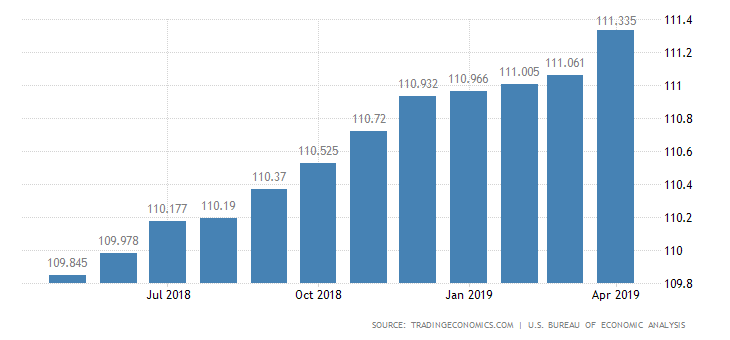
The Fed is again at the forefront of investor’s attention. After a decade of trying to right the ship, through various programs, we find ourselves again at an economic crossroads. Do they continue with their dovish stance on monetary policy, simply stay the course or even ramp things up by cutting rates? In order to determine this, it’s important to ascertain what key metrics the Fed looks at. After all, they have stated that they will be data-driven in their decisions. One very important, yet underreported, piece of data is the
personal consumption expenditure deflator or PCE.

The personal consumption expenditure deflator index measures the prices paid by consumers for goods and services. It is one of two followed measures of consumer prices. Because the consumer price index and the PCE index are based on different underlying concepts, they are constructed differently and tend to behave differently over time. The CPI garners more attention from the public; the Fed’s preferred measure of inflation is the PCE deflator. The “core” PCE price index is defined as personal consumption expenditure (PCE) prices excluding food and energy. The core PCE price index measures the prices paid by consumers for goods and services without the volatility caused by movements in food and energy prices to reveal underlying inflation trends. Food prices consist of those included in the PCE category of “food and beverages purchased for off-premises consumption.” Prices included in the PCE category “food services and accommodations” are not included in the “food” price index because these services prices tend to be far less volatile than those for food commodities such as meats, fresh vegetables, and fruits. Energy prices consist of those included in the PCE categories of “gasoline and other energy goods” and of “electricity and gas” utilities.

The metric has its strengths and weaknesses like anything else:

Strengths

  • Of all the measures of consumer price inflation, the PCE deflator covers the broadest set of goods and services.
  • The weights change based on shifts in consumer spending while the weights for the CPI are fixed for two years.
  • the PCE index measures the change in goods and services consumed by all households, and nonprofit institutions serving households.

Weaknesses

  • Released after the CPI.
  • Medical care services have a large weight on the PCE. Therefore, deviations in medical care costs can cause the PCE to differ noticeably from the CPI.
Follow me on Twitter @MikeShorrCBOT

about the author:

Mike Shorr

Since 1994, Michael has been an on-the-floor market maker, Vice-President of Interest Rate Derivatives for Knight Financial Products and Director of Education and Options Instructor at Trading Advantage. He makes the oftentimes complex world of options and trading accessible to the novice and advanced trader alike. Michael has a Bachelor of Science degree in Statistics and Finance from the University of Illinois Champaign-Urbana. He presently is Director, Trader Education at ProsperTradingAcademy.

Read Similar Articles

February 15, 2026

Why Option Premiums Rise Before Binary Events

Ever wonder why option premiums rise before binary events in the stock market? It’s not uncommon for option prices to spike ahead of major announcements like: For context, I like to describe option premium as the difference between the contract’s price and intrinsic value. It’s essentially what buyers pay for the “hope” that an option […]

Read Article
January 21, 2026

Could Penny Stocks Be The Big Play In 2026?

Written By: Howard Greenberg As everyday traders put their trading plans into action for 2026, penny stocks might not be on many of their radars. It’s totally understandable why penny stocks may not appeal to the more calculated seasoned traders. Their reputations for susceptibility to manipulation, extreme volatility, and low liquidity make them way too […]

Read Article
January 13, 2026

Credit Card Interest Rate Caps: What Traders Could Expect

A high-profile policy debate has re-entered the financial spotlight surrounding credit card interest rate caps. Last week, President Donald Trump called for a temporary national cap on credit card interest rates. He proposed a maximum annual rate of 10% over a one-year period, starting January 20, 2026. President Trump’s proposal would aim to combat the […]

Read Article

Read Similar Articles

https://www.prospertrading.com/volatility-skew-scott-shares-an-intriguing-market-theory/Volatility Skew: Scott Shares An Intriguing Market Theory
March 4, 2026

Volatility Skew: Scott Shares An Intriguing Market Theory

Volatility skew is the difference in Implied Volatility (IV) between out-of-the-money (OTM) calls and puts with the same expiration date. It signals market sentiment by showing whether traders are paying more for downside protection (puts), or upside potential (calls). As a result, this type of trading action creates a “skewed” shape in the volatility surface […]

Read Article
https://www.prospertrading.com/six-ways-to-put-synthetic-trading-into-action/Six Ways To Put Synthetic Trading Into Action
March 1, 2026

Six Ways To Put Synthetic Trading Into Action

Have you ever heard of synthetic trading? In a nutshell, it’s a unique trading strategy, where traders use combinations of options contracts—and sometimes the underlying stock—to replicate the risk/reward profile of another position. The type of position a trader might try to replicate could include owning stock, shorting stock, or holding a single call or […]

Read Article
March 1, 2026

War, What is it Good For?

Edwin Starr made this song famous back in 1970 and we are about to see how it may impact global markets in the coming weeks. This past week, financial and tech stocks were hit hard by a handful of persistent investor worries on Friday, with U.S. stocks suffering their largest monthly percentage declines in a […]

Read Article