The March 2026 Jobs Report was among the most anticipated ones in recent memory.
Right now, the economy is being shaped by a number of factors:
- The Iran Conflict
- Surging Oil Prices
- Interest Rate Uncertainty
- Mass Layoffs
These current circumstances — combined with February’s bad jobs report — had traders preparing for the worst. Fortunately, the March 2026 Jobs Report looked much better than expected…at least at first glance.
In reality, some of the key metrics it showed were relatively frontloaded…and a little misleading.
The underlying numbers depict a more grounded reality that still points to a cooling labor market with capped momentum. From a trading perspective, the markets will likely view it as “better than feared” rather than a sign of renewed strength.
I’ll highlight the March 2026 Job Report’s positives, negatives, and which parts of the market I believe traders should consider watching.
The Good

Job Growth Shattered Expectations
One of the biggest surprises in the March 2026 Jobs Report was nonfarm payrolls, which showed an increase of 178,000. Not only did these numbers greatly exceed forecasts in the 60,000 range, but they showed a sharp rebound from February’s revised loss of 133,000. Wage growth remained steady, with average hourly earnings rising 0.2% month-over-month (3.5% year-over-year). The unexpected payroll spike signalled continued resilience in the U.S. economy, with inflation pressures tied to labor showing signs of stability.
Declining Unemployment
The March 2026 Jobs Report showed a slight decrease in unemployment, which fell to 4.3% from 4.4%. The total number of unemployed individuals declined by 332,000. This suggests the labor market is still holding firm, even as broader economic uncertainty lingers.
Solid Gains In Key Sectors
Looking under the hood, job growth was highly concentrated in a core group of sectors. Healthcare led the way with 76,000 new jobs, which was largely driven by the recovery from last month’s strikes. Other key sectors that experienced significant job growth included construction (+26,000) along with transportation and warehousing (+21,000). The gains in these sectors point to continued strength in infrastructure and logistics.
If today’s job’s report is making you think twice about the stocks you’re targeting, Charlie Moon believes A.I. trading can give traders a uniquely powerful edge in these markets. If you’re interested in getting Charlie’s next batch of A.I. trade ideas, he recorded this video with more information.
The Bad
Misleading Unemployment Numbers
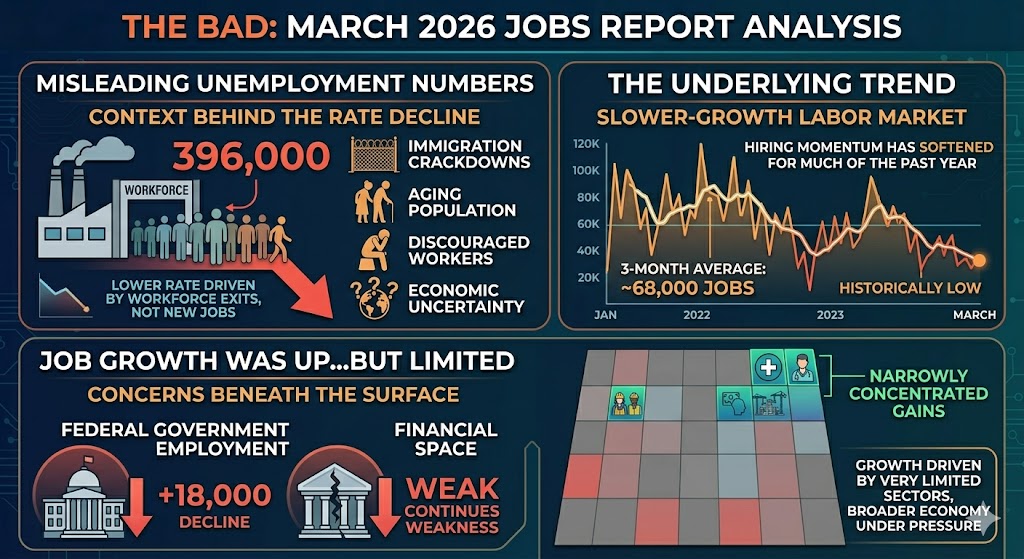
The lower unemployment numbers were a huge positive…but they need some context. A big reason the unemployment rate declined is because roughly 396,000 people exited the workforce. This was driven by key factors including crackdowns on immigration and deportation efforts, an aging population, discouraged workers (ie, people who aren’t actively looking for employment), and economic uncertainty. It signals that fewer people are looking for work in an already-sparse job market, suggesting it’s not as strong as the headline numbers imply.
The Underlying Trend
While the March 2026 Jobs Report showed a headline rebound, the underlying trend still points to a slower-growth labor market. Even with March’s stronger print, the three-month average sits around 68,000 jobs. Those numbers are historically low, and suggest that hiring momentum has softened for much of the past year. To sum it up: One strong report doesn’t necessarily signal a sustained acceleration.
Job Growth Was Up…But Limited
Although job growth was much higher than expected, the March 2026 Jobs Report revealed some concerns beneath the surface. Like the unemployment figures, job growth metrics were also misleading to a notable degree. It showed large gains in key sectors, however, overall job growth remains narrowly concentrated and very limited. At the same time, federal government employment declined by 18,000, while areas in the financial space continued to exhibit weakness. These could be signs that parts of the economy are still under pressure.
What To Expect Moving Forward
Geopolitics & Surging Oil Prices
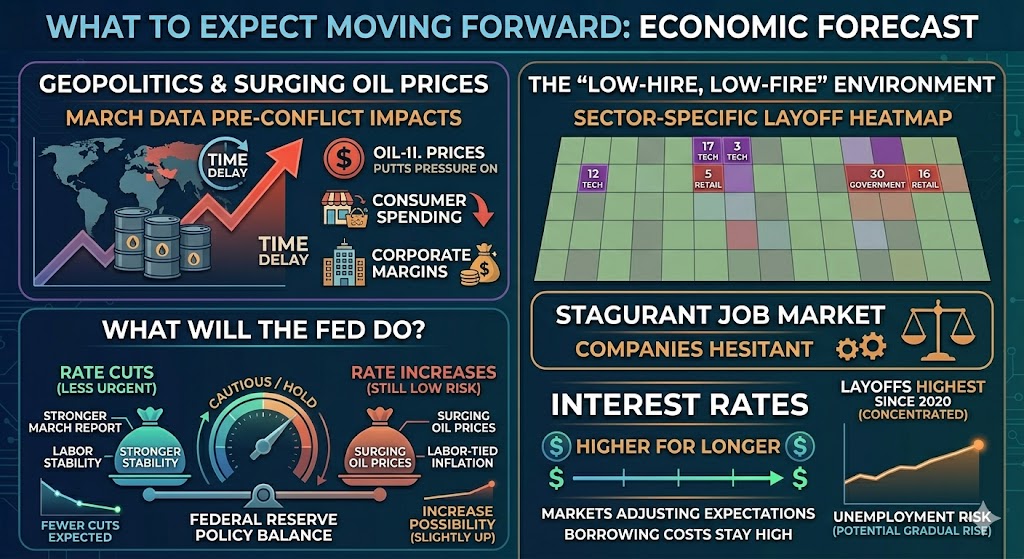
Most of the March 2026 Jobs Report’s data was completed before the impacts of the Iran conflict — and rising oil prices that resulted — hit. That means the real effects will probably not show up until future jobs reports. As energy prices continue to climb, consumer spending could slow, particularly in sectors like retail, restaurants, and leisure. At the same time, higher costs may squeeze corporate margins and push real wages lower, creating additional economic drag.
The “Low-Hire, Low-Fire” Environment
The broader trend still points to a stagnant job market, with many companies hesitant to aggressively expand or cut employees. Although layoffs are at their highest levels since 2020, they’re concentrated in certain sectors — tech, government, retail — and aren’t widespread. The March 2026 Jobs Report shows the labor market seems to still be in slow-growth mode, with limited broad momentum. This points to the potential for modest payroll gains ahead, but also keeps the risk of a gradual rise in unemployment alive, especially if oil prices stay elevated.
What Will The Fed Do?
From a policy standpoint, the Federal Reserve is likely to remain cautious, since a stronger jobs report reduces the urgency for rate cuts. Right now, the labor market is in an awkward spot. It’s by no means booming, but considered strong enough, where rate cuts are no longer a given. Currently, I believe the Fed will likely keep rates where they are, with the possibility of increases still relatively low (but more likely than they were in previous months). The markets are now adjusting expectations for fewer rate cuts, which could keep borrowing costs higher for longer.
Implications For Traders

For traders, the March 2026 Jobs Report shows a more nuanced and complex picture. A stronger labor market could support equities…but also reduce the likelihood of near-term rate cuts. In environments like these, where markets are highly sensitive to Fed news, this could potentially put pressure on growth stocks. On the other hand, softer underlying trends and uneven job growth could keep the door open for future easing, while also increasing the chances of choppier, murkier market conditions.
This push and pull between strength and weakness is where sector rotation, volatility, and shifting interest rate expectations start to play a bigger role. Instead of a clear trend, I believe traders could likely see selective opportunities across different areas of the market.
Given the mixed signals from today’s jobs report, I believe traders should consider watching the following sectors:
- Energy
- Consumer Discretionary
- Financials
- Tech
Rising oil prices tied to geopolitical tensions could continue to support energy stocks. At the same time, they could also put pressure on consumer-facing sectors like retail and travel if spending tightens. I believe that financials are worth watching, as interest rate expectations shift and impact lending, margins, and overall sentiment. Meanwhile, tech and growth stocks could remain sensitive to Fed policy. If rate cuts get pushed further out, I think stocks that fall in those categories could face continued headwinds, despite broader market resilience.
With market uncertainty not expected to cease any time soon, it could be a lot tricker to pinpoint the right trades. Charlie Moon’s “A.I. Autopilot Algo” helps him access dozens of the market’s highest-profit potential trade ideas in minutes each morning. Watch this video to find out how it all works.
Final Takeaways
The March 2026 Jobs Report delivered a headline surprise…but the real story lies beneath the surface. While job growth and declining unemployment offered a sense of relief, the broader trend still points to a slower, more fragile labor market. This is a classic case of “better than feared,” not a signal that the economy is back to full strength.
For traders, this distinction matters. Markets are caught in a crosshairs between conflicting forces: Resilient data that supports equities, and underlying weakness that keeps uncertainty — and volatility — alive. Throw in rising oil prices, geopolitical tension, and shifting Fed expectations, and you’re looking at an environment that’s anything but straightforward.
This isn’t a market for autopilot trading. It demands awareness, flexibility, and discipline. Sector rotation is likely to remain active, trends may be shorter-lived, and reactions to macro data could be more pronounced.
Right now, I think the real edge comes from adaptability — understanding the bigger picture, while being selective with execution. In markets like this, it’s not about predicting the next move perfectly…butt being prepared for multiple outcomes and reacting accordingly.
Sometimes the fastest way of adapting to markets is by innovating. Charlie Moon followed that approach, and adopted a whole new way of trading options with this “A.I. Autopilot Algo” tool he uses. If you want to learn how it can help you access a daily list of high-profit potential trade ideas every single morning, Charlie recorded this video with all the details.