

This is a tough “Week Ahead” folks. There is so much economic and geo-political news to parse through but I’ll do my best.
Stocks tumbled in volatile trading Friday as the U.S.-Israel conflict with Iran showed no sign of abating and oil prices continued their ascent. The S&P 500 closed at its lowest level in six months but saw a quick spike higher just after the market closed when President Trump posted something to the effect of “winding down operations.” (More on that later).
Despite this comment, the conflict in the Middle East showed no signs of easing. The U.S. military was deploying an amphibious assault ship with thousands of additional Marines and sailors to the Middle East, while Iran’s new supreme leader hailed Iran’s “unity” and “resistance.”
The market seems to be finally settling into the idea that this may go on longer than initially expected and may go on not for just a few weeks, but maybe beyond several months.
Meanwhile, fears that inflation is reigniting and that rate cuts from the Federal Reserve are off the table pushed Treasury yields higher on Friday, further contributing to the stock market’s weakness. U.S. rate futures show the Fed is now more likely to raise interest rates than cut them by the end of 2026, according to CME’s FedWatch tool.
Friday marked the once-in-a-quarter simultaneous expiry of derivatives contracts tied to stocks, index options and futures, also known as “triple witching,” and volume on U.S. exchanges was heavy, with 27.5 billion shares traded, compared to an average of 20.1 billion shares over the previous 20 sessions.
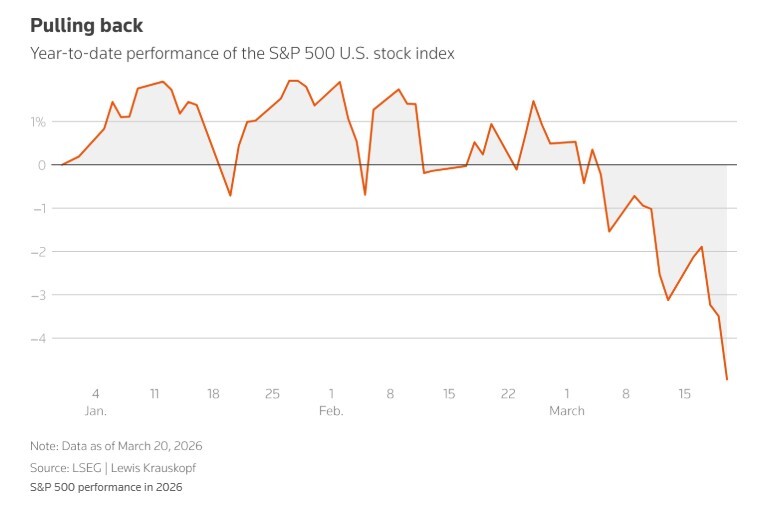
For the week, the Dow lost -2.1% to 45,557, the S&P 500 closed lower by -1.9% to 6,506, the Nasdaq gave back -2.1% to 21,648 and the Russell 2000 declined by -1.6% to 2,441. The CBOE Volatility Index actually closed lower by -1.5% to 26.78.
Help Mr. Clampett

It is no surprise that oil markets continue to move higher as the Strait of Hormuz remains effectively closed, disrupting roughly 20 million barrels per day of oil and petroleum products from reaching global markets. However, the conflict is now expanding, with strikes targeting oil storage facilities, pipelines, and—critically—natural gas infrastructure. While oil disruptions are significant and will likely be felt for months, the impact on liquefied natural gas (LNG) could prove even more prolonged and economically damaging.
Liquefied natural gas (LNG) is a relatively newer component of the global energy complex. It is created by cooling natural gas to approximately -260°F, converting it into a liquid form that significantly reduces its volume. This process allows LNG to be transported efficiently across long distances by specialized tankers. LNG has become essential for countries in Asia and Europe, supporting heating, power generation, and industrial demand. Europe has increasingly relied on LNG imports to replace Russian natural gas following the ongoing Russia–Ukraine conflict.
Unfortunately, LNG infrastructure is now coming under direct threat in the Middle East, creating supply disruptions that are far more difficult to offset due to limited global capacity. Iran’s largest gas field, South Pars, was reportedly struck, and in retaliation, Iran targeted the Ras Laffan LNG hub in Qatar—responsible for approximately 20% of global LNG supply. Reports indicate “extensive damage,” with production taken offline.
While the United States is a major LNG exporter, its current capacity is constrained at roughly 16 billion cubic feet per day. Although new export facilities are under construction, meaningful capacity increases will not fully materialize until later this decade, with gradual ramp-ups expected by 2030.
The current energy shock extends well beyond oil flows. If LNG infrastructure continues to be targeted, global natural gas markets could face a more persistent supply imbalance, increasing the risk of sustained inflationary pressure worldwide.

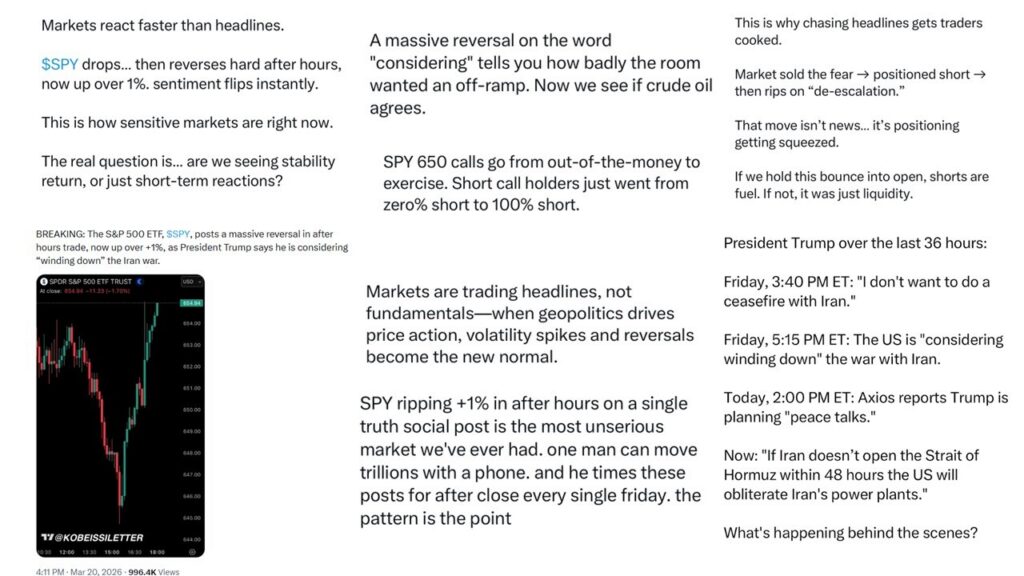
As we have discussed for the last several weeks, the markets are extremely difficult to trade. Bid/ask spreads are wide and liquidity has sunk. I have mentioned a big part of that is the fact that the market is unfortunately trading on what seems a minute by minute update on the war in Iran, with most of the “updates” contradicting one another.
I gathered these posts within an hour after the close of the market on Friday. NONE OF THESE, I REPEAT NONE OF THESE, are mine.
My point is that the constant news flow on social media can and is driving market activity.
BE CAREFUL FOLKS! It is my belief that trading on this news flow is not just irresponsible but flat out dangerous.
Not So Fast
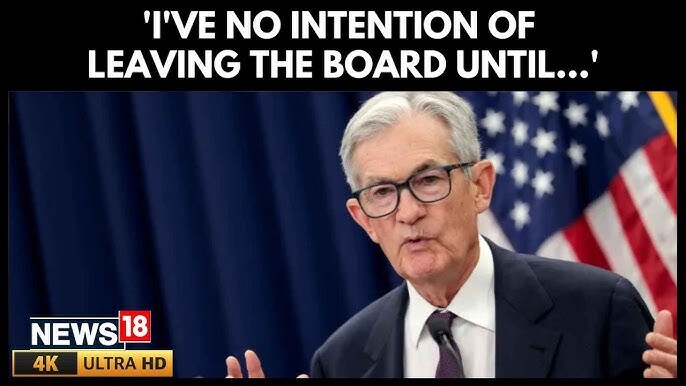
Rates are jumped this week after Fed Chair Powell communicated said during the FOMC presser that he isn’t leaving the central bank until the DOJ case against him is closed. Despite his term as head ending in May, he could stay on as governor if he so chooses. This is certainly anything but dovish for the market. This development, in conjunction with the ECB and BoE stating that they are prepared to start hiking if need be to temper the adverse effects of the Middle East war, has Wall Street effectively pricing in no rate cuts in 2026.
Treasuries also sold off (pushing rates higher) in response to another lighter-than-expected initial unemployment claims report which continue to weaken the argument that labor conditions require imminent monetary policy accommodation to avoid deterioration. But the curve is ascending in bear-flattening fashion led heavily by the shorter-tenors by a difference of about 8 basis points, as duration hangs in there in consideration of slowdown concerns and stronger odds of demand destruction causing inflation expectations to soften.
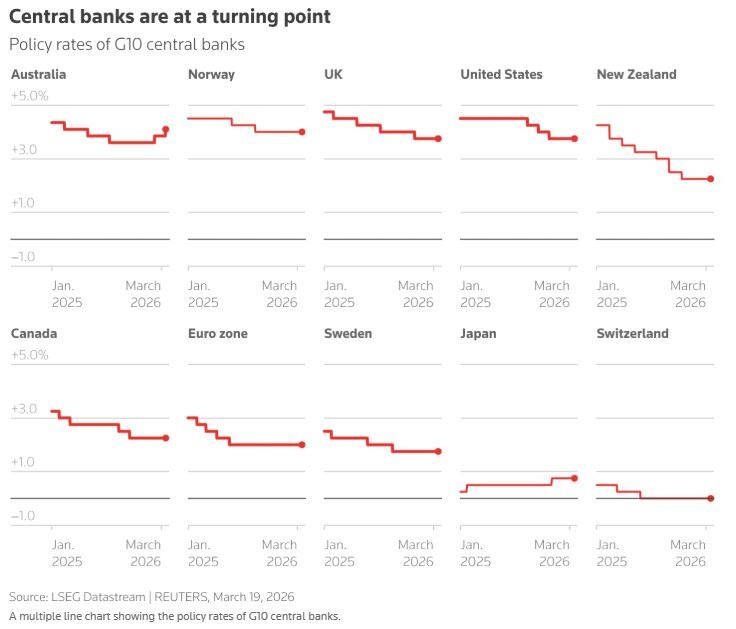
The risk of a resurgence in inflation comes not long after central bankers battled the biggest jump in inflation in decades resulting from Russia’s invasion of Ukraine in 2022. At its peak, the average rate of inflation exceeded 10 percent in the eurozone and 11 percent in Britain. Policymakers responded by aggressively raising interest rates, which had painful consequences for homeowners, businesses and government budgets.
The European Central Bank, Bank of England and Bank of Japan all held interest rates steady on Thursday, a day after the Fed did the same, as they face a new inflationary threat from higher energy prices. While policymakers at each bank had been grappling with different economic circumstances, they have been united again by the prospect that a long disruption to energy supplies could push up prices in their regions.
Since the war began, traders have slashed bets on monetary easing this year for the Federal Reserve and priced rate increases elsewhere, including by the European Central Bank and Bank of England. The Reserve Bank of Australia, already in hiking mode, raised rates again this week.

Economic Reports of Note (All Times EST):
Monday
8:30 am – US: Chicago Fed National Activity
10:00 am – US: Construction Spending
11:30 am – US: 3 & 6-month Bill Auctions
1:00 pm – US: Atlanta Fed GDPNow
Tuesday
8:15 am – US: ADP Weekly Employment Change
8:30 am – US: Nonfarm Productivity
8:55 am – US: Redbook
9:45 am – US: S&P Global Manufacturing, Services & Composite PMI
10:00 am – US: Richmond Manufacturing & Services Index
1:00 pm – US: 2-year Note Auction
Wednesday
3:00 am – UK: CPI & PPI
7:00 am – US: Mortgage Data
8:30 am – US: Import/Export Index
10:30 am – US: Crude Oil Inventories
1:00 pm – US: 5-year Note Auction
11:00 pm – JAP: Bank of Japan CPI
Thursday
8:30 am – US: Weekly Jobless Claims
11:00 am – US: KC Fed Composite & Manufacturing Index
11:30 am – US: 4 & 8-week Bill Auctions
1:00 pm – US: 7-year Note Auction
4:00 pm – US: Fed Governor Cook Speaks
Friday
8:30 am – US: Retail Inventories
10:00 am – US: Michigan Consumer Sentiment
11:30 am – US: FOMC Member Daly Speaks