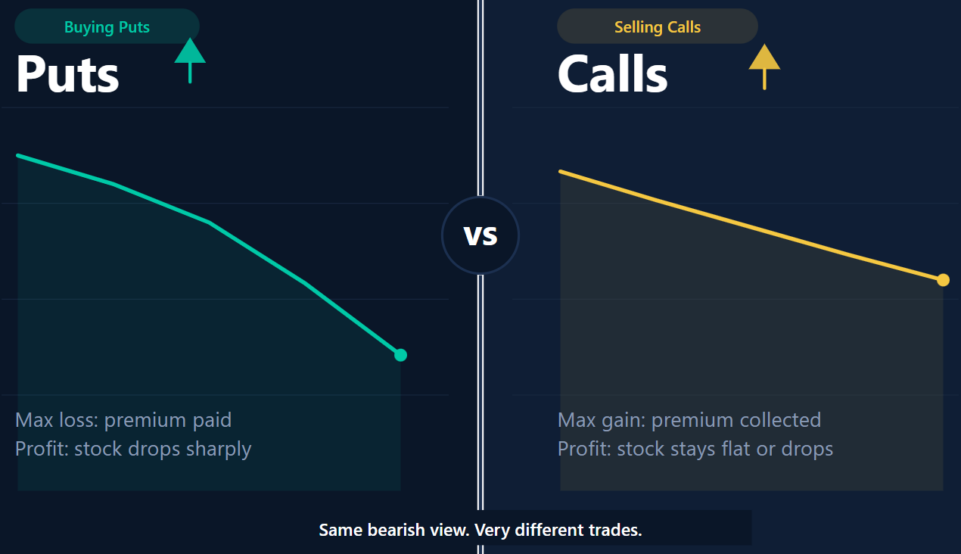
When traders expect a stock to drop, options give them more than one way to potentially profit from that move. Two of the most common bearish options strategies traders use in these situations are buying puts and selling calls.
When presented with both options, some traders might ask: “If they’re both bearish options trades, aren’t they technically the same thing?”
The answer: Absolutely not.
While both are designed to benefit from downside price action, they work very differently from each other. The mechanics, risk profiles, and market conditions that make each one effective are all distinct.
I’ll break down the differences in how each trade works, and the specific scenarios where each one makes the most sense.
Buying Puts vs Selling Calls: How They’re Similar
Both Are Bearish Strategies
Buying a put and selling a call are both designed to profit when a stock moves lower or stays under pressure. If you’re bullish on a stock, neither of these is the right tool for the job.
Both Involve Options Contracts
Both trade types use options contracts tied to a specific stock, strike price, and expiration date. Understanding the fundamentals of how options are priced and expire is essential for executing either trade effectively.
Both Factor In Time Decay
Time decay — the gradual erosion of an option’s value as expiration approaches — plays a key role in both types of trades. How it affects each trade is where they begin to diverge.
Buying Puts vs Selling Calls: The Differences

While they’re fundamentally similar, how types of options trades work, and the ideal scenarios for using each one are vastly different. In addition to the chart above, this section will dive into the specific distinctions between buying puts and selling calls.
I buy puts and sell calls in many of the option trading strategies I follow in my Options Essentials Program. They’re very useful tools for managing risk, maximizing profit potential, and playing both sides of market volatility. If you’re interested in learning more about my program, you can fill out an application on this page to get started.
Buying Puts
When you buy a put, you’re acquiring the right to sell a stock at a specific price — known as the strike price — before the contract expires. You pay a premium upfront to enter the trade. That premium is your maximum loss. Your profit potential is substantial: The more the stock drops below your strike price, the more your put is worth.
When To Buy A Put
You would consider buying a put when you have a strong directional conviction that a stock is expected to drop — and drop meaningfully. Common scenarios include before a bad earnings report you’re anticipating, when a stock breaks a key technical level, or as a hedge to protect a long position you already own. Ideally, you would want implied volatility to be relatively low when you buy, so you’re not overpaying for the option.
The chart below outlines the different types of puts you can buy:

Selling Calls
When you sell a call, you’re giving someone else the right to buy a stock from you at a specific price (also the strike price) before the contract expires. You collect the premium upfront. That premium represents your maximum profit potential on the trade. Unlike buying a put, your risk when selling a call is theoretically unlimited on a naked position. If the stock shoots significantly higher, losses can be substantial.
When To Sell A Call
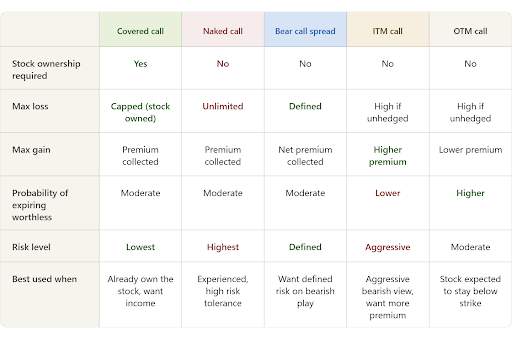
You would consider selling a call when you think a stock is going to stay flat or drift slightly lower, but you don’t necessarily expect a big move down. The most common and conservative version is a covered call — where you already own the stock, and sell a call against it to generate potential income. You could also consider selling a call as part of a spread to cap your risk. Ideally, you would want implied volatility to be high when selling, so you potentially collect more premium.
The chart below shows the different types of calls you can sell:
The Bottom Line
Although buying puts and selling calls both offer opportunities to potentially profit from a bearish outlook, they’re built for very different situations.
Buying puts is a risk-defined trade that requires the stock to move down significantly in your favor.
Selling calls is a more passive, income-oriented approach, where you aim to profit from time decay, and the stock not going up. However, without having a long stock or another long call position, this has unlimited risk potential.
Neither strategy is officially better than the other. The ideal choice usually comes down to your market outlook, risk tolerance, and how big of a move you’re expecting in the underlying stock. Understanding the differences between them is what separates reactive traders from intentional ones.
Want to find out how I leverage these two types of option trades — and how you can start working with me in the process? They help me structure many of the trade signals I release in my Options Essentials Program to target high-profit potential plays, no matter what direction a stock moves.
Check out this page, and fill out an application to get started.