Many options traders focus on one direction at a time. However, risk reversals can force you to focus on two directions simultaneously.
Buy a call. Buy a put. Maybe sell a covered call against something you already own.
That’s exactly what makes them so powerful…and dangerous, if you don’t know what you’re doing.
I’ll walk through this strategy from the ground up, explain the hidden edges and risks it contains, and how traders can leverage these setups.
What Is a Risk Reversal?
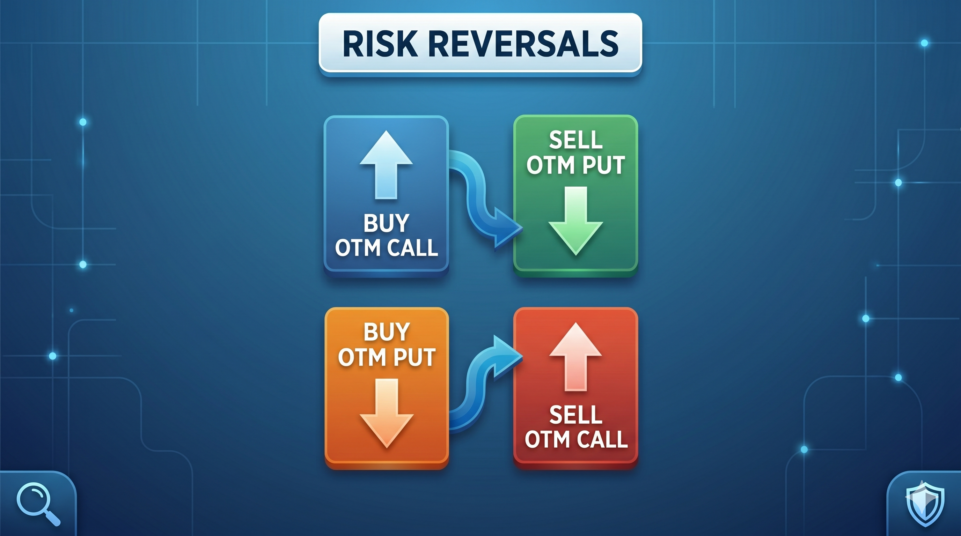
In a nutshell, risk reversals are two-legged options trades. You buy an out-of-the-money (OTM) option on one side, and sell an out-of-the-money option on the other, using the premium from the sale to finance the purchase.
There are two main types of risk reversals: Bullish and bearish
Bullish Risk Reversal: Buy an OTM call. Sell an OTM put to pay for it.
Bearish Risk Reversal: Buy an OTM put. Sell an OTM call to pay for it.
Typically, you’re working with the same expiration and similar deltas on both sides.
For example, if you’re selling a 25-delta call, you would buy something close to a 25-delta put.
In theory, it seems pretty straightforward, but there’s quite a few moving parts that go into these setups.
Understanding Skew: The Hidden Edge
Before you even consider trading risk reversals, I believe it’s important to understand something called skew.
Within any given expiration, the implied volatility of different strikes is not the same. In a typical equity, puts carry a higher implied volatility than calls at equal distances from the current price. As a result, your skew curve slopes upward to the downside.
Why? Supply and demand.
Think about who owns stocks. The vast majority of investors are typically long.
That makes them:
- Natural buyers of puts because they want protection.
- Natural sellers of calls because they’re happy to collect premium against shares they already hold.
On top of that, markets historically move faster and more violently to the downside than the upside. Because of this, there’s usually more collective fear baked into put pricing.
Risk Reversal: META Trade Example
Let’s go over an example of what trading risk reversals look like. In a recent episode of Market Minds, I did an in-depth breakdown on these setups, using Meta Platforms Inc. (META) as an example:
The analysis, insights, and strategies shared by Prosper Trading Academy’s coaches in Prosper Insider are strictly for educational and informational purposes only. All content reflects the personal opinions of the coaches and should not be construed as specific investment advice or recommendations. Any examples discussed are illustrative in nature and do not represent actual live trade signals or instructions to buy or sell securities. Trading involves risk, and individuals should carefully evaluate their own financial situation before making investment decisions.
META is one of the core 5-7 stocks I mainly follow for day trading options. If you want to learn the other names I like to trade, and the 3-step system I use, grab a copy of my day trading cheat sheet to get the full scoop.
The Bottom Line
Risk reversals aren’t for everyone. The margin requirements can be significant, and the delta management requires thorough attention.
When skew is mispriced, and when the market is clearly more afraid of one direction than the other, there’s an edge to be found. The key is understanding exactly what you own, what you’re short, and where your risk actually lives before you put on the trade.
That’s the foundation of trading with an edge rather than trading on hope.
Want to learn more about how I trade and the stocks I follow? My day trading cheat sheet lists the 5-7 stocks I mainly follow for day trading options, and a step-by-step walkthrough of my go-to system. If you’re interested, go to this page to grab a free copy.