

It was a busy shortened week in the markets. From earnings to GDP to PCE and then, oh yeah, a Supreme Court ruling, the markets ended higher. After bouts of volatility earlier in the week, equities stabilized into Friday’s close, with market participants reassessing growth expectations and policy risk.
A key catalyst arrived from the nation’s highest court. In a 6-3 ruling, the U.S. Supreme Court struck down tariffs imposed by President Donald Trump, curbing the administration’s use of emergency authority to impose sweeping trade levies without explicit congressional approval, (more on this below).
On the economic front, growth showed clear signs of cooling. The Bureau of Economic Analysis reported that U.S. GDP expanded at a 1.4% annualized pace in the fourth quarter of 2025, well below the prior quarter’s 4.4% rate and under consensus expectations of 2.8%. But a luke warm PCE report cast some doubt into whether inflation is under control (more on that below as well).
This week we turn to results from NVDA. Will the world’s largest company by market cap and AI bellweather deliver as the tech sector and other megacap stocks have struggled? That’s the million dollar question. The expectation for outsized results from NVDA has been a persistent theme over the last few years. AI “hyperscalers” have announced plans to ramp up capital spending to build out data centers and other infrastructure, which often utilize Nvidia’s equipment, setting the stage for the company to deliver strong results, but…
For the week, the DOW gained +0.3% to 49,626, the S&P 500 rallied +1.1% % to 6,910, the Nasdaq added +1.5% to 22,686 and the Russell 2000 advanced +0.7% to 2,667. The CBOE VIX closed -7.3% lower to 19.09.

U.S. economic growth slowed more than expected in the fourth quarter amid disruptions from last year’s government shutdown and a moderation in consumer spending, but tax cuts and investment in artificial intelligence were expected to support activity this year.
Gross domestic product increased at a 1.4% annualized rate last quarter, the Commerce Department’s Bureau of Economic Analysis said in its advance estimate of fourth-quarter GDP on Friday. Economists polled by Reuters had forecast GDP rising at a 3.0% pace. The survey was, however, completed before data on Thursday showing the trade deficit widening to a five-month high in December.
The economy grew at a 4.4% pace in the third quarter. The nonpartisan Congressional Budget Office estimated the government shutdown would subtract 1.5 percentage points from fourth-quarter GDP through fewer services provided by federal workers, lower federal spending on goods and services and a temporary reduction in Supplemental Nutrition Assistance Program benefits.
The report, which was delayed by the record 43-day government shutdown, highlighted a jobless economic expansion as well as a “K-shaped” economy, in which upper-income households are doing well while lower-income consumers are struggling amid high inflation from import tariffs and stalling wage growth.
US Inflation Increases
Underlying U.S. inflation increased more than expected in December, and signs are pointing to a further acceleration in January, which would strengthen expectations that the Federal Reserve would not cut interest rates before June.
The personal consumption expenditures price index, excluding the volatile food and energy components, rose 0.4% after an unrevised 0.2% gain in November, the Commerce Department’s Bureau of Economic Analysis said on Friday. It is one of the measures tracked by the U.S. central bank for its 2% inflation target.
Economists polled by Reuters had forecast the so-called core PCE price index climbing 0.3%. In the 12 months through December, core PCE inflation advanced 3.0% after increasing 2.8% in November.
Those forecasts could change after January’s Producer Price Index report this coming Friday. January’s PCE inflation data will be released on March 13. The reports have been delayed by last year’s shutdown of the government.

The US Supreme Court struck down Trump’s sweeping tariffs. What now?
The US Supreme Court struck down President Trump’s sweeping global tariffs on Friday, undercutting his signature economic policy and delivering the president his biggest legal defeat since he returned to the White House. In turn, Trump said he would impose a new global 10% tariff and that he was “ashamed of certain members” of the Supreme Court.
The court, affirming an earlier ruling by a federal appeals court, said Trump exceeded his authority by invoking emergency powers to impose his “reciprocal” tariff scheme across the globe. (The Republican’s increase in tariffs last year was the largest since the Smoot-Hawley duties of 1930. WHO REMEMBERS FERRIS BUELLER?) Dissenting Associate Justice Brett Kavanaugh said the refund process was “likely to be a ‘mess’” – the fight over $170 billion in refunds has already started.
Markets reacted positively (at least for now) as investors are preparing for a likely upheaval in US trade policy.
American consumers and companies have borne the majority of the tariff burden, research has shown. Studies by the New York Fed and a German economic think tank recently showed the U.S. absorbed close to 90% of last year’s tariff increases.
Tariffs have so far had a muted impact on inflation, however, largely because companies have tried to swallow costs in the past year rather than passing them onto consumers.
Here are four big takeaways for investors.
- Trump will push for tariffs in other ways
The Supreme Court blocked Trump’s ability to impose tariffs through the International Emergency Economic Powers Act, a law that allows the president to regulate economic activity in emergency events. But there are a handful of other legal avenues the president could use to try to impose tariffs again, according to Michael Brown, a senior research strategist at Pepperstone.
- It’s possible new tariffs could be implemented at lower rates
Trump suggested that new tariffs could be even more severe than the ones he implemented last year, but it’s likely that import duties will be lower due to the legal precedent set by the SCOTUS ruling, according to Heather Long, the chief economist at Navy Federal Credit Union.
- Tariff refunds are uncertain, but could bring corporate stimulus
The positive market reaction on Friday suggests that investors think tariff refunds are a possibility, according to Pepperstone’s Brown.
Joseph Brusuelas, the chief economist at RSM US, said he believed the US would likely issue between $100 billion and $130 billion in tariff refunds.
“When one thinks about the fiscal tailwind that may inject $100-150 billion in cash to American households this year in addition to tariff refunds we are talking real money,” he wrote in a post on X, referring to the amount households are expected to get in tax refunds this year.
- Concerns about the deficit are on the rise
Bond yields ticked higher shortly after the Supreme Court ruling on tariffs, a sign that concerns are beginning to swell over the US debt picture again, now that tariff revenue, for the moment, has been taken off the table.
“Tariffs had been functioning as a shadow tax that helped fund spending without explicitly raising taxes. Remove that and the deficit widens, borrowing rises, and historically that is the type of development that leans on the bond market and pressures yields higher,” Mark Malek, the CIO of Siebert Financial, wrote in a note on Friday.
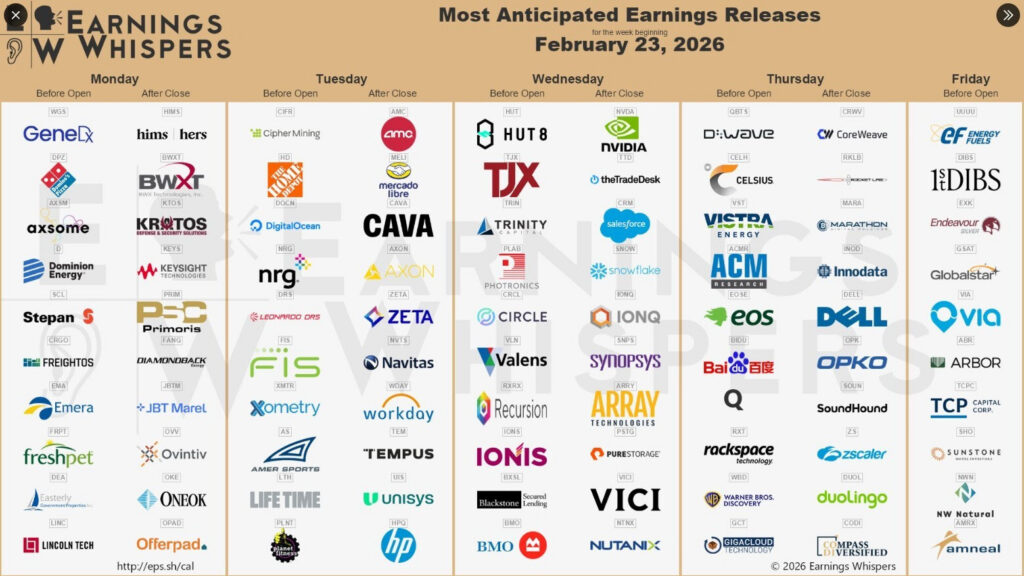
Economic Reports of Note (All Times EST):
Monday
8:30 am – US: Chicago Fed National Activity
10:00 am – US: Factory Orders
10:00 am – US: Durables
10:00 am – US: Dallas Fed PCE
11:30 am – US: 3 & 6-month Bill Auctions
Tuesday
8:00 am – US: Fed Member Goolsbee speaks
8:15 am – US: ADP Weekly Employment Change
8:55 am – US: Redbook
9:00 am – US: FOMC Member Bostic Speaks
9:00 am – US: House Price Index
9:00 am – US: Fed Member Collins Speaks
9:10 am – US: Fed Member Waller Speaks
9:35 am – US: Fed Governor Cook Speaks
10:00 am – US: CB Consumer Confidence
10:00 am – US: Richmond Manufacturing & Services Index
10:00 am – US: Wholesale Inventories
10:30 am – US: Dallas Fed Services
11:30 am – US: Atlanta Fed GDPNow
1:00 pm – 2-year Note Auction
3:15 pm – US: FOMC Member Barkin Speaks
Wednesday
5:00 am – EUR: CPI
7:00 am – US: Mortgage Data
9:30 am – US: FOMC Member Barkin Speaks
10:30 am – US: Crude Oil Inventories
1:00 pm – US: 5-year Note Auction
Thursday
8:30 am – US: Weekly Jobless Claims
10:00 am – US: FOMC Member Bowman Speaks
11:00 am – US: KC Fed Composite & Manufacturing Index
11:30 am – US: 4 & 8-Week Bill Auctions
1:00 pm – US: 7-year Note Auction
Friday
8:30 am – US: PPI
8:30 am – CAN: GDP
9:45 am – US: Chicago PMI
10:00 am – US: Construction Spending
11:30 am – US: Atlanta Fed GDPNow
We hope you had a great weekend. See you all tomorrow.
Scott, Charlie, Mike, Jeff, Dan, Howard and the entire Prosper Team.