

The S&P 500 and Nasdaq closed at record highs on Friday, boosted by robust earnings and a dip in crude prices, and turning the page on their biggest monthly percentage gains in years. They both logged their sixth straight weekly advance, their longest run of weekly gains since October 2024.
As May begins, the stock market embarks on what is historically a weak six-month stretch. From 1945 through April 2026, the S&P 500 has gained an average of about 2% from May to October, according to data from Fidelity. That compares with an average gain of about 7% from November through April. (More on that below).
Wrapping up a momentous week for corporate earnings, in which reporting companies accounted for more than two-fifths of the S&P 500’s total market capitalization, analysts now see aggregate first-quarter earnings growth of 27.8%, year-on-year, according to LSEG I/B/E/S. That’s an 11.7 percentage point increase from where the estimate stood a week ago, and marks the biggest earnings growth since the fourth quarter of 2021.
Five of the companies in the Magnificent Seven group of artificial intelligence-related stocks reported this week, and investors paid close attention to the timing and extent to which huge investments in the nascent technology are starting to pay off.
More than 100 companies in the S&P 500 are set to post results this week, with markets digesting the heart of the reporting season. As mentioned above, the 27.8% growth is set to be the highest profit growth rate since the fourth quarter of 2021.
For the week, the Dow gained 0.6% to 49,499, the S&P 500 added +0.9% to 7,230 the Nasdaq closed higher by 1.1% to 25,114 and the Russell 2000 advanced +0.9% to 2,813. The CBOE Volatility Index closed lower by -9.2% to 16.99.
The S&P 500 gained 10.4% in April, the best monthly performance since November 2020, when a pandemic-stricken market got news of a Covid-19 vaccine. For red-hot chip stocks it was even better: the PHLX Semiconductor Index, or SOX, ripped 38.4% higher, its best performance since February 2000—a month before the dot-com boom started to bust.
In addition to the stellar month the S&P 500 registered, the Nasdaq’s monthl gain of 15.3% was its largest since April 2020. The Dow’s monthly advance was its biggest since November 2024.
April 2026 Market Performance
- Best Month Since 2020: The S&P 500 (10.4% gain) and Nasdaq (15.3% gain) achieved their strongest performance since April/November 2020.
- Dow Jones: The Dow ended April with a 7.1% advance.
- Record Highs: The S&P 500 and Nasdaq concluded the month at new closing highs, according to Markets News, April 30, 2026: S&P 500, Nasdaq Hit New Highs, Post Biggest Monthly Gains Since 2020; Dow Jumps 800 Points.
Sector Performance & Key Drivers
- Tech & AI Focus: The information technology sector rose 17.44% in April, while communication services led with an 18.43% gain.
- Mixed Big Tech Earnings: Alphabet (GOOGL) surged 10%, while Meta and Microsoft dropped over 3% after their reports.
- Lagging Sectors: Energy was the worst-performing sector, shedding 3.51% in April.
Investor Outlook
- Rate Hikes: Concerns about inflation led to a slight rise in bets for potential Fed rate hikes, with an 11.8% chance of a 25-basis-point hike in 2026.
- Volatility: Despite the gains, high-tech valuations are under scrutiny, with experts pointing out similarities to February 2000 in terms of rapid run-ups.
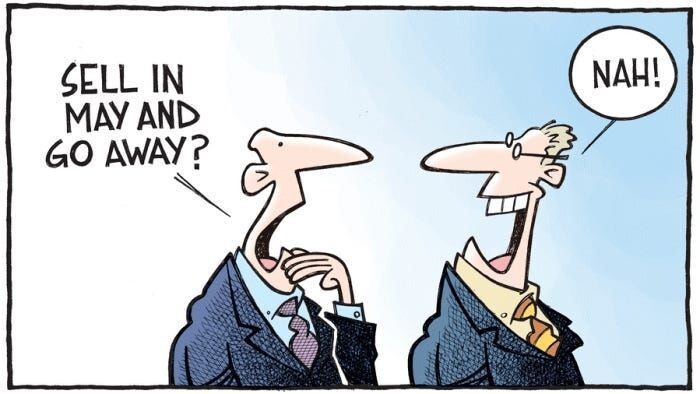
SELL IN MAY AND GO AWAY???
Investors should take the above April statistics at face value, accepting that stocks have proved resilient amid geopolitical turmoil and that earnings—which have inspired much of the gains—is perhaps the most important data point.
Yet the fact that major parts of the market saw their best months since the ominous years of 2020 and 2000 should tell investors we are not dealing with normal market conditions.
History would urge caution. The S&P 500 has gained 10% or more in a month 30 times since 1928—with just four cases since 1992—and on average gained just 1.6% the following month.
One of the most popular pieces of conventional investing wisdom couldn’t be more misguided, according to a recent analysis from Bloomberg Intelligence. So what’s the real story behind the age old adage of Sell in May and Go Away?
For more than a century, the phrase “sell in May and go away, and come back on St. Leger’s Day,” has been treated as dogma by many financial pundits. The logic behind it is firmly rooted in 19th-century London; back then, the city’s financial elite would regularly escape their stuffy urban environs during the summer months. This often coincided with lower trading volumes, and dismal returns. (For the unfamiliar, the St. Leger Stakes is a British horse race that typically takes place in mid-September.)
However, over the past 33 years, , stocks rose during the May-through-October period 25 times. By comparison, during the period between January and May, stocks registered gains on only 23 occasions. (These performance figures are based on the State Street SPDR S&P 500 ETF Trust an ETF that aims to track the S&P 500 ($SPY).

To be sure, this analysis leaves out the months of November and December — historically strong months for stock-market returns.
And to be clear, returns during the May-through-October period have historically been weaker. Dow Jones Market Data analysis found that through October 2025, the S&P 500 has averaged a gain of 2.4% during the six-month period ending in October, compared with an average gain of 5.2% in the six-month period ending in April. That is according to performance data going back to 1928.
Over the past 30 years, win rates for the November-through-April period have been slightly higher than win rates for the May-through-October period.
But things have started to shift over the past decade. Since 2016, the S&P 500 has averaged a gain of 6.9% during the six-month period ending in October. That compares with an average gain of 6.2% during the six-month period ending in April. Last year, the S&P 500 fell 4% between New Year’s Day and the end of April, before rallying hard through the summer.
Bottom line: This year, investors have better reasons to sell stocks as the summer months approach. The Iran conflict is dragging on with no end in sight, and higher energy prices could eventually boost inflation, pressuring the Federal Reserve to leave interest rates on hold or perhaps even raise them. But…reflexively selling assets in May isn’t as compelling an argument as it once was.

Economic Reports of Note (All Times EST):
Monday
10:00 am – US: Factory & Durable Orders
11:30 am – US: 3 & 6-month Bill Auctions
11:30 pm – AUS: RBA Interest Rate Decision
Tuesday
8:00 am – US: Building Permits
8:55 am – US: Redbook
9:45 am – US: S&P Composite & Global PMI
10:00 am – US: New Home Sales
10:00 am – US: JOLTS
10:00 am – US: ISM Non Manufacturing
11:30 am – US: Atlanta Fed GDPNow
Wednesday
5:00 am – EU: PPI
7:00 am – US: Mortgage Data
8:15 am – US: ADP Nonfarm Employoment Change
1:00 pm – US: Fed Member Goolsbee Speaks
Thursday
7:30 am – US: Challenger Job Cuts
8:30 am – US: Weekly Jobless Claims
10:00 am – US: Construction Spending
11:00 am – US: NY Fed 1-Year Consumer Inflation Expectations
11:30 am – US: Atlanta Fed GDPNow
11:30 am – US: 4 & 8-week Bill Auctions
Friday
8:30 am – US: April Nonfarm Payrolls
9:45 am – US: ISM Manufacturing PMI
11:30 am – US: Atlanta Fed GDPNow