Earnings continued to move stocks this past week as the S&P 500 and Russell 2000 hit new highs. The S&P 500 index on Thursday crossed 7,800 for the first time after hitting an intraday all time high of 7,816.70. With the S&P 500 trading just below record highs, the index is valued at about 20 times expected earnings. That is up from about 19 at the end of July and below 22 at the start of 2026.
And the earnings story remains strong. With roughly 450 companies having reported, about 85% have exceeded expectations, well above historical norms, led by technology, industrials, and healthcare.
But what really may have fueled new highs this week was a slew of “slowing” ecodata. While inflation related to high oil prices remains a concern, recent economic data has investors mostly expecting the Federal Reserve to hold interest rates steady at its September meeting. Traders see a 67% chance the Fed will keep rates unchanged at the September meeting, with a 33% chance of a hike, according to CME’s FedWatch.
Looking away from the economic calendar, the technology sector was another major theme for the week. After sliding in June, the artificial intelligence trade made a strong comeback at the end of July and into the beginning of August. Chip stocks, which have been the primary driver of the AI trade, logged a stellar start to this month after a more than 20% slide in July. They lost steam this week amid a lack of major AI-related earnings, though they still eked out gains.
For the week, the DOW lost -0.6% to 53,732, the S&P 500 added +0.4% to 7,786, the Nasdaq eked out a +0.1% gain to 26,729 and the Russell 2000 closed higher by 1.1% to 3,068. The CBOE VIX decreased by -4.4% to 14.25.

Tame Inflation
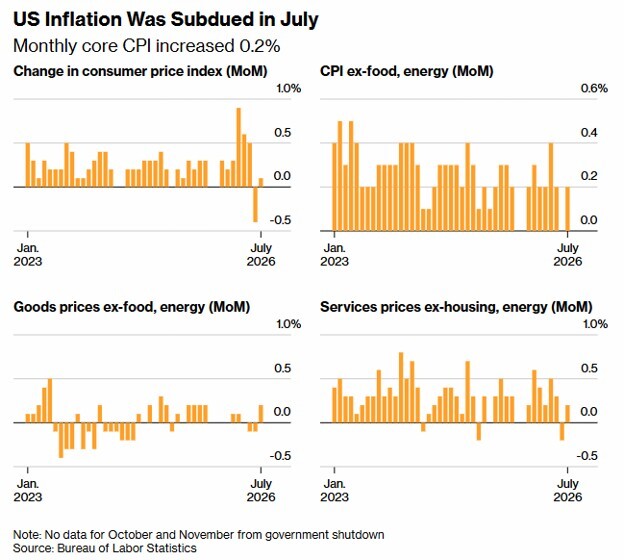
Underlying US inflation was subdued in July, likely easing pressure on the Federal Reserve to raise interest rates.
The consumer price index, excluding often-volatile food and energy categories, increased 0.2% from June, according to Bureau of Labor Statistics data out Wednesday. On an annual basis it advanced 2.5%, matching the slowest pace since March 2021. Overall, consumer prices rose 0.1% from June and 3.4% last year.
The report suggests the impact of the energy-price shock from the Iran war continued to fade in July. The figures may give the Fed more room to weigh inflation pressures against a recent slowdown in hiring as it debates whether to lift borrowing costs at its Sept. 15-16 meeting.
Policymakers will see additional reports on employment and inflation before the September meeting, and investors will be listening closely to Fed Chairman Kevin Warsh’s expected remarks at the central bank’s annual Jackson Hole symposium later this month.
The news should give some breathing room to those Fed officials who want to be patient.
Energy and gasoline prices fell for a second month. US gasoline prices rose above $4 a gallon again in July after a US-Iran ceasefire collapsed and hostilities reignited, but remained lower on average across the entire month than in June.
Grocery prices meanwhile, fell for the first time since March, thanks in part to a record decline in the cost of lettuce amid the cyclospora outbreak. Uncooked ground beef prices fell 1.6%, the most since 2020.
Shelter prices rose 0.1%, restrained by a 3.3% decline in hotel and motel rates, the most in more than a year. The report’s measures of rents both rose 0.3%.
Services prices, excluding energy and rents, rose a modest 0.2% following a decline the month before, according to data compiled by Bloomberg. Medical care and airfares were among services categories that saw rising prices.

That’s Exactly What Bond Investors Did
The US government sold 30-year bonds at the highest interest rate in a quarter century, a testament to investors’ demand for greater compensation to finance the nation’s growing deficit.
The yield at the $25 billion sale Thursday came in at 5.216%, the most since 2001, even as a drop in oil prices supported US debt in secondary-market trading. The sale, which was met with decent demand, followed the Treasury Department’s 10-yearr auction on Wednesday that drew the highest financing cost at that timeline since 2007.
If investors continue demanding greater compensation for inflation and fiscal risks, long-term yields could move higher and away from 5% even if Treasury auctions remain well covered. This could pose a huge headache for President Trump and Treasury Secretary Bessent ahead of midterm elections in November. Record government financing costs are already feeding through to the broader economy, after years of elevated inflation and government spending.
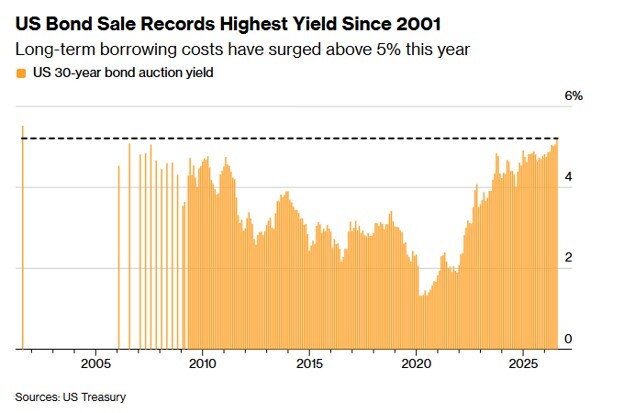
Long-term yields surged past 5% this year on investor concerns that a rise in energy prices — tied to war in the Middle East — will boost cost pressures, forcing the Federal Reserve to keep interest rates elevated for years to come. That’s on top of heightened Treasury supply from years of fiscal deficits, a sudden increase in corporate borrowing to fund the artificial-intelligence boom, and softening demand from traditional buyers of long-dated bonds.
Treasury yields are the center of the US financial universe, serving as the benchmark for everything from corporate debt to housing loans. Last week, the average for a 30-year fixed mortgage increased to 6.69%, the highest since July 2025.
Further Slowing
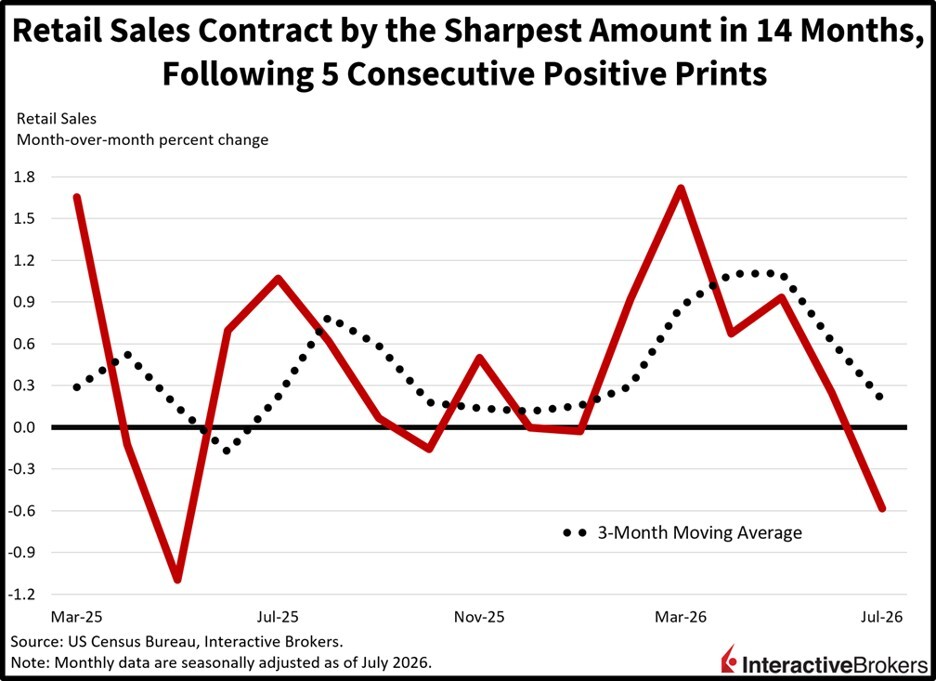
The path to avoiding a 2026 rate hike became a bit clearer after a pair of reports signaling stressed household budgets re-ignited slowdown angst on Wall Street. A colossal double miss on retail sales and consumer sentiment is worrying investors that affordability pressures, dwindling savings and reduced hiring could mean that the engine of the economy could be on its last legs.
July retail sales posted the sharpest drop in 14 months in a sign that consumers may be getting exhausted as the year progresses. The headline dropped 0.6% month over month (m/m), materially worse than the 0.1% growth expected and the 0.2% increase from June.
The economy is highly dependent on consumer spending – close to 70% of GDP can be traced back to it – so it’s a case of be careful what you wish for, because too big a slowdown, and especially too prolonged a slowdown, could end up hurting corporate profits and, in turn, the stock market.
A weaker consumer could weaken pricing power in the critical AI space, as waning spending appetites from individual end users could spread to enterprises, risking a deceleration in corporate earnings. Furthermore, deteriorating household expenditures may not offer as much interest rate relief as Wall Street became accustomed to during previous slowdowns.
Overall, investors shouldn’t be hoping for sluggish consumption data and job losses to drive looser financial conditions, since that combination is poised to punish stocks; however, fixed income is certainly geared to outperform in a softer cyclical environment. Finally, the weeks ahead will provide insights into whether slower shopping and heavy payroll contractions represent a short-term slump or present a real risk of an economic downturn.

Economic Reports of Note (All Times EST):
Monday
8:30 am – CAN: CPI
10:00 am – US: NAHB Housing Market Index
11:30 am – US: 3 & 6-month Bill Auction
Tuesday
8:30 am – US: Housing Starts & Building Permits
8:55 am – US: Redbook
9:15 am – US: Industrial & Manufacturing Production
9:15 am – US: Capacity Utilization Rate
10:00 am – US: Pending Home Sales
10:45 am – US: Atlanta Fed GDPNow
Wednesday
2:00 am – UK: CPI & PPI
5:00 am – EU: CPI
7:00 am – US: Mortgage Data
10:30 am – US: Crude Oil Inventories
11:00 am – Cleveland CPI
1:00 pm – US: 20-year Bond Auction
2:00 pm – US: FOMC Meeting Minutes
Thursday
8:30 am – US: Philadelphia Fed Manufacturing Index
8:30 am – US: Weekly Jobless Claims
11:30 am – US: 4 & 8-Week Bill Auctions
1:00 pm – US: 30-year TIPS Auction
Friday
9:45 am – US: S&P Global Manufacturing, Services & Composite PMI