
I recently closed a winning live trade signal in Arista Networks Inc. (ANET). The trade ran over the course of a few days, and I set it up using one of my favorite options strategies.
I’ll walk you through how the trade unfolded, what the final results showed, and the options strategy I used to set it all up.
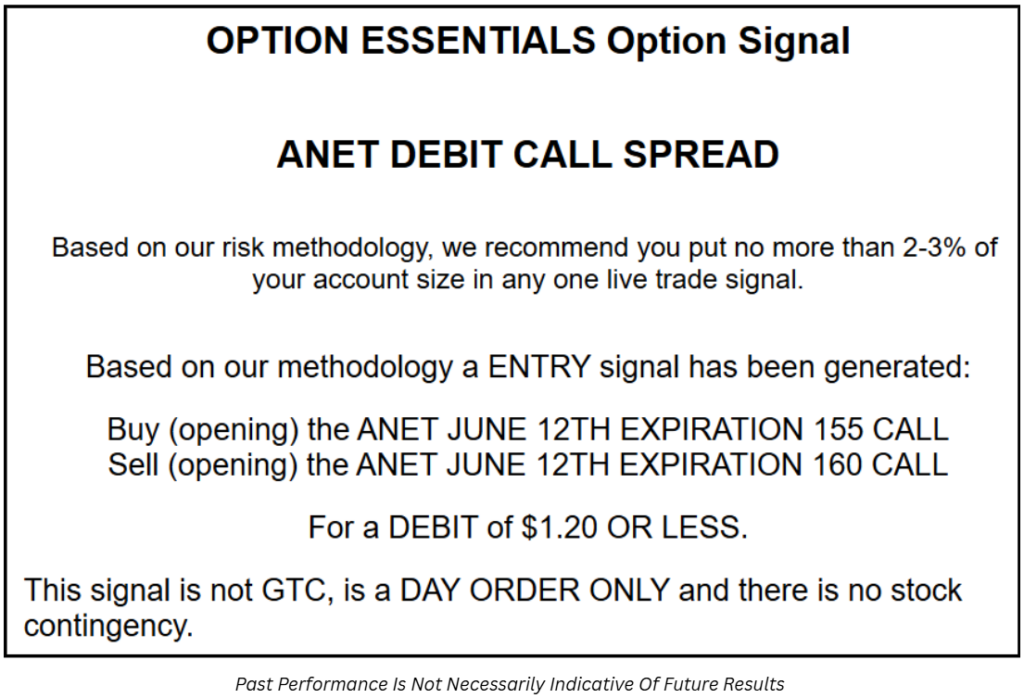
ANET Trade Signal
ANET reported earnings on May 5. The report was solid, but the market didn’t care. The stock sold off nearly 20% in the days that followed.
That’s when I started paying attention.
After the dust settled, ANET began climbing back. I spotted something important: Massive buying support at the 200-day moving average.
That level acted like a floor. The stock had no business staying down. I saw a rebound setting up, and made my move.
I released the trade signal on May 21. With ANET trading at $145.17, I bought the $155 call, and sold the $160 call for a net debit of $1.20, using the June 12 expiration for both options.
The next day (May 22), ANET climbed to $151.26. I took a partial exit, and collected a $1.80 credit.
I held the rest until May 26, when the stock hit $155.09. That’s when I made my full exit on the trade, collecting a $2.25 credit.
The trade signal’s final results showed a +70.19% return.
The strategy that made it all possible? A vertical call spread.
It’s one of my go-to options trading strategies that I’ve used in some of my biggest winning trade signals. I’ll break down exactly what a vertical call spread is, when to consider using it, and why I chose this particular strategy in the ANET trade.
What Is A Vertical Call Spread?
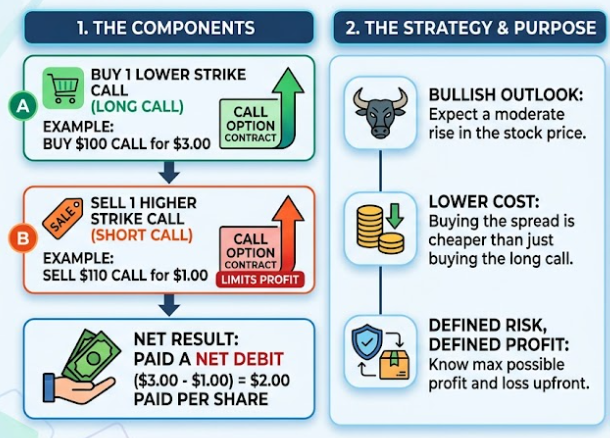
A vertical call spread is a bullish options strategy, where you buy one call and sell another call on the same stock. Both options use the same expiration date, but have two different strike prices.
It’s essentially two options in one trade.
Here’s how it’s structured:
- You buy the lower strike call to capture the upside move you’re expecting in the stock
- You sell the higher strike call to offset the cost of the trade
- The difference between what you pay and what you collect is your net cost to enter the trade
Using the ANET trade as an example, I bought the $155 call, and sold the $160 call. Both options expired on June 12. I paid $1.20 to enter. That was my maximum risk on the trade.
A vertical call spread can be structured two ways: As a debit or a credit.
When you pay to enter the trade, it’s called a debit spread. That’s what I used here. I believed ANET was heading higher, so I paid $1.20 upfront for the right to profit if it did.
A credit spread works the opposite way. You collect money upfront, and profit if the stock stays below a certain level.
You calculate these values by subtracting the costs of both option contracts. For the ANET trade, I bought the $155 calls at $3.25 per contract, and sold the $160 calls at $2.05 per contract. The difference comes to $1.20.
The biggest advantage of a vertical call spread is how it defines risk. Your max risk is capped at what you paid. Your max reward is capped at the width of the strikes. No surprises. No blown accounts.
It also costs less than buying a call outright. Selling the higher strike brings in credit that reduces my cost to enter. That means I need less capital at risk to make the same directional bet.
That combination of lower cost and defined risk is why I love this strategy.
When To Use A Vertical Call Spread
There are a few ideal scenarios for using a vertical call spread:
First is when you have a directional bias, but also want to limit your downside. If you believe a stock is heading higher, but you don’t want to risk the full premium of buying a naked call, a vertical spread lets you enter the trade at a lower cost.
Another is if you have a price target in mind. Since vertical call spreads have a defined ceiling on profit, it can work really well if you identify a realistic level where the stock is likely headed. You’re not trying to catch every point of the move. Instead, you would be targeting a specific range.
Lastly, is when implied volatility is elevated. Selling the higher strike call could help offset some of the inflated premium in the market. That makes the trade cheaper to enter and can tilt the odds in your favor.
All three conditions lined up in the ANET trade. I had a clear directional bias to the upside after seeing strong support at the 200-day moving average. I set my price target based on the structure of the chart. Post-earnings implied volatility was also still elevated, which made selling that $160 call even more attractive.
The Bottom Line
The ANET trade is a good example of what to look for when building an options position: A stock with a clear reason to move, a defined level of support, and a strategy that limits risk while keeping meaningful upside on the table.
A vertical call spread isn’t the right tool for every situation…but when the strategy lines up, it can let you structure a trade with a clear max risk, target, and lower cost to enter than buying a call outright.
That’s the edge. Not just picking the right stock, but knowing which strategy fits the moment.