
The Nasdaq wrapped its best two-month stretch in more than two decades with a fresh closing high on Friday.and the Dow closed above 51,000 for the first time. The S&P 500 registered its ninth consecutive weekly gain, its longest winning streak since December 2023.
The Nasdaq rose 25% in April and May, which was its best two-month run since October and November 2002. The Dow and S&P 500 had their best two-month runs since 2023 and 2020, respectively.
The latest companies reporting earnings have carried the torch from earlier in the spring. Dell results drove tech shares higher, while investors awaited details on a potential U.S.-Iran deal. Technology stocks have led a resurgent market on the back of strong profit outlooks driven by the AI boom, after tech and other influential megacap stocks were hit hard in March.
The big report this week will be the May nonfarm payrolls report on Friday. Markets are definitely looking for some labor market resilience amid the concern that persistent inflation will lead to rate hikes that could be very unwelcome for stocks. May’s payrolls report is expected to show an unemployment rate of 4.3% and an increase of 85,000 jobs, according to a Reuters poll as of Friday.
An increase of more than 150,000 jobs might be problematic for equities if it fuels fears about an “overheating” economy that also drives U.S. Treasury yields higher.
For the week, the Dow gained +0.9% to 51,032, the S&P 500 added +1.4% to 7,580, the Nasdaq closed higher by +2.4% to 26,973 and the Russell 2000 moved higher by +1.8% to 2,919. The CBOE Volatility Index dropped -8.3% to 15.32, it’s lowest level since January.
Never A Doubt

As mentioned above, the major U.S. stock indexes wrapped up May at record levels, while the Nasdaq Composite clocked in its best two-month stretch in decades. More reports reports that the U.S. and Iran had reached a deal to extend their ceasefire and remove restrictions on vessels crossing the Strait of Hormuz kept the upward momentum moving along. This comeback since March is truly remarkable. Hopefully you didn’t sell in April or May (at least at the beginning!)
The decline in oil prices has played a big part in helping U.S. stocks on their way to gains in May. The bounce back in equities has been massive, with the benchmark S&P 500 having surged about 16% since the end of March.
“We’re finishing out an excellent May after an even more impressive April. This would make the third very solid May in a row, and the 12th up May in the past 13 years. There are not as many examples of strong May performances coming on the back of big April gains, and those have tended to come as the result of major monetary and/or fiscal stimulus – very much unlike this time,” Interactive Brokers’ Steve Sosnick told Investing.com.
The S&P is now on the verge of powering past the 7,600 points level for the first time ever, having hit a session high of 7,599.38 points on Friday. The gauge ended May with a gain of 5.2%. The Nasdaq was up 8.4% for May, while the Dow 2.8%.
From a technical perspective, the S&P 500 regained momentum quickly after gapping above its 200-day moving average in April and has since moved decisively to new record highs above the 7,000-point milestone. Momentum indicators continue to confirm the bullish trend, although several measures are now approaching short-term overbought territory following the magnitude and speed of the advance.
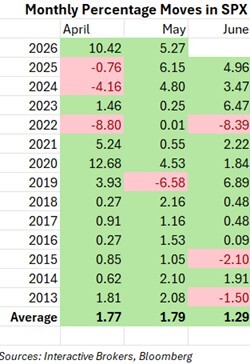
Selling this May – or in fact, many of the recent prior Mays – has not been a winning trade. In fact, SPX has experienced only one down May in the last 13 years. Only July and November can make that same claim. The only prior down May in that period was in 2019, when it fell 6.58%.
Each of the last two Mays has featured advances of similar magnitudes to this one. Furthermore, each of the prior three Mays, including 2023’s very slight upturn, was followed by substantial gains in June. As the table above shows, only three June swoons have occurred since 2013 as well.
Another major driving factor in the U.S. market rally has been sustained gains in technology stocks, as AI demand and spending reaches a fever pitch.
“The AI story is helping to offset the negatives from the Iran war, the consequent oil price spike, and continued uncertainty over a resolution to the conflict. With each foray followed by a retreat, markets have become increasingly numb to Trump’s bellicose and grandiose statements. The markets hope that as the midterms approach, the chances for a lasting cease fire increase, whether or not U.S. goals have been achieved,” Emily Hill, CEO at Bowersock Capital Partners, said.
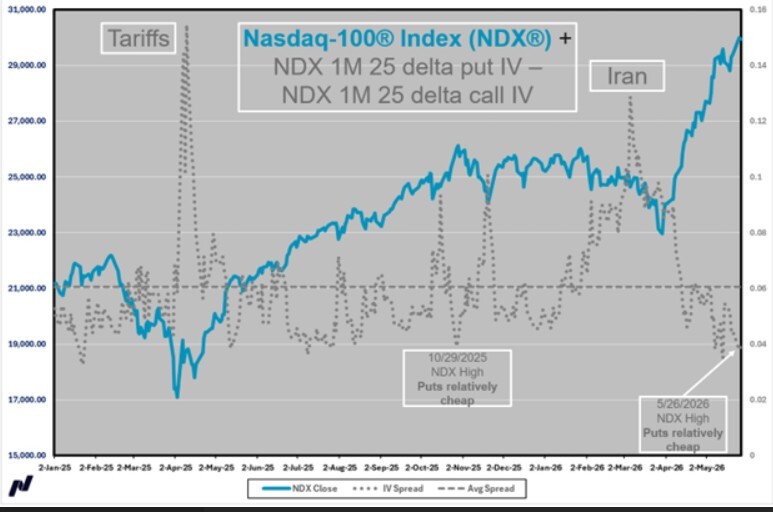
If you’ve spent any time in options markets, you know they don’t just reflect prices, they can reveal feelings. Over the past year and a half, the Nasdaq-100 options market has had an emotional journey. Fear, panic, cautious optimism, quiet confidence, and, at present, something that looks a lot like a victory lap.
We are talking about the spread between implied volatility (IV) on 1-month, 25 delta NDX puts and calls. We typically see put IV trading well above call IV as the market pays up for downside protection. Fear is the dominant feeling. But when that spread declines, the hedges come off and calls become relatively pricey — the current feeling has shifted to “what’s the upside?“
It’s truly a simple measure and over the past year-plus, it has told a remarkably coherent story. From the start of last year through late May of 2026, on average, the 1M NDX puts have traded at a 6 vol point premium to the calls. Check this out:
Calm Before the Tariff Storm
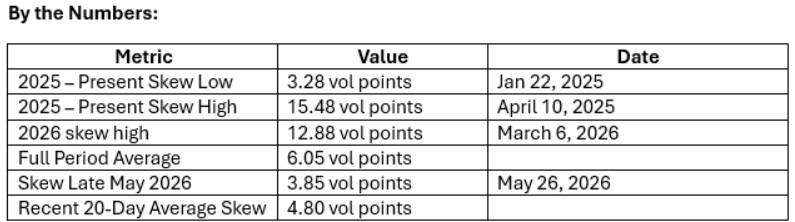
The year 2025 opened quietly. Through January and into early February, the put/call IV spread sat near its lowest readings in the dataset, bottoming at 3.28% on January 22 as NDX hummed along near 21,000. Low skew, low anxiety — investors were content. Puts and calls were priced in relative harmony.
Then came April. Tariff turbulence hit equities with a severity that genuinely shocked markets. NDX plunged to a closing low of 17,398 on April 4, and on April 7, intraday prices touched 16,542, a 20% drawdown (bear market) from the start of the year.
The IV spread exploded in response, expanding to ~15.5% on April 10. Nearly five times the January lows. In the modern market, risk arguably gets repriced faster than ever before.
NDX didn’t stay down for long. By late April, a sharp reversal was underway. The index climbed from the ~17,000s back toward 20,000 through May. By summer 2025, NDX had fully recovered its April losses and was pushing toward new highs. The spring fear receded, and a more balanced market tone returned.
But starting in November 2025 and extending well into Q1 2026, the put/call IV spread began climbing again. NDX churned in a narrow range as market leadership shifted.
The coordinated bombing campaign in Iran shifted sentiment rapidly in the month of March the vol spread had reached another peak around ~13% as headline risk came roaring back. The vol spread was elevated by any measure, and even more notable given that NDX was less than 5% off previous highs.
The narrative backdrop was real: concerns about geopolitical risk, valuation headwinds, and the lingering question of whether the 2025 recovery had legs. Investors were nervous even when the scoreboard looked okay. And, as in April 2025, the corollary was on the table. Call options were relatively inexpensive throughout this stretch, particularly for anyone willing to look past the anxiety and lean into potential upside. And that’s just what the market did. It looked past the headlines and social media posts and focused on increased earnings and record profit margins.
Since late March when NDX closed below 23,000, the index surged nearly 30%, settling just above 30,000 on May 26th. Along the way, multiple all-time highs have been established. As this has transpired, the put/call IV spread collapsed in concert, falling to 3.94%. As of late May, we’re near the lowest reading in the last year and a half.
The fear premium has been almost entirely unwound. Investors who were urgently buying downside protection in January and February are now looking up, not down. Call demand has surged in relative terms. Skew has flipped from “hedge everything” to “where’s the upside?”
So what does it all mean?
When NDX was near its 2025 lows, fear was peaking and calls were at their cheapest relative levels. Now, with the index near record highs, the mood has reversed. Calls are priced at a relative premium compared to those stress-period lows and puts are arguably cheap.
Whether the current skew environment reflects genuine conviction, a reduction in macro uncertainty, or just the market exhaling after a long stretch of anxiety is a question without a clean answer. The skew data is clear: the market’s “mood ring” has gone from deep red to a cheerful green in a remarkably short period of time.
Economic Reports of Note (All Times EST):
Monday
9:45 am – US: S&P Global Manufacturing PMI
10:00 am – US: ISM Manufacturing Employment & PMI
10:00 am – US: Construction Spending
11:30 am – US: Atlanta Fed GDPNow
11:30 am – US: 3 & 6-month Bill Auctions
Tuesday
5:00 am – EU: CPI
8:55 am – US: Redbook
10:00 am – US: JOLTS
Wednesday
5:00 am – EU: PPI
7:00 am – US: Mortgage Data
8:15 am – US: ADP Nonfarm Employment Change
9:00 am – US: Fed Vice Chair Barr Speaks
9:45 am – US: S&P Global Composite & Services PMI
10:00 am – US: ISM Non-Manufacturing Employment & PMI
10:00 am – US: Durables & Factory Orders
10:30 am – US: Crude Oil Inventories
2:00 pm – US: Beige Book
Thursday
7:30 am – US: Challenger Job Cuts
8:30 am – US: Weekly Jobless Claims
11:30 am – US: 4 & 8-week Bill Auctions
1:10 pm – US: FOMC Member Daly Speaks
Friday
5:00 am – EU: GDP
8:30 am – US: May Nonfarm Payrolls