
Global Impact

Financial markets endured another turbulent week ending as investors tried to reconcile cooler inflation data with an energy shock severe enough to revive stagflation fears. Despite the noise, the broader market has held up better than the headlines suggest. The S&P 500 (SPX) is still trading within roughly 5% of its all-time high, a sign that while volatility is elevated and confidence has clearly been shaken, investors and traders still appear willing to step in on any favorable macro or geopolitical news in what remains a volatile but resilient tape.
Energy dominated the week. Crude first exploded higher as the Iran conflict escalated, with futures briefly spiking toward $120 a barrel early in the week. Prices then violently reversed, sliding to roughly $75 by midweek, only to rebound again toward the psychological $100 level by Thursday as supply concerns in the Middle East intensified. The scale of those swings made it difficult for investors to treat this as a routine commodity move. Instead, the oil action reopened the possibility that geopolitical supply shocks could push inflation back up even as growth slows, which is why stagflation worries returned so quickly.
That macro mix was brutal for equities. All major S&P 500 sectors traded the week lower except energy, which naturally benefited from the oil spike. Financials were the worst-performing sector, down more than 4%, as investors refocused on private-credit fragility and the risk of an asset-liability mismatch if funding costs stay high while collateral values soften. Consumer discretionary was the second-worst performer, reflecting growing concern that higher fuel costs and broader inflation pressure will erode household purchasing power and weigh on spending across travel, retail, and leisure. The broad tone of the market was defensive even though the major indexes never fully broke to the downside.
Volatility remained elevated throughout. The VIX spiked to 35 on Monday and, even after easing, stayed in the mid-20s into week’s end. That is high enough to signal real stress, but not yet the kind of panic associated with forced liquidation across the board. The market has clearly become more fragile, but it has not become indiscriminately disorderly. That distinction matters, especially with the S&P still relatively close to its highs.
Get ready for the week ahead – between Iran and the Fed we should be in for another volatile one.
For the week, the Dow lost -2% to 46,558, the S&P 500 closed lower by -1.6% to 6,632, the Nasdaq gave back -1.3% to 22,105 and the Russell 2000 declined by -1.8% to 2,480. The CBOE Volatility Index, after peaking near 35, closed lower by -7.8% to 27.19.
Economic Impact

Oil and gas prices are on the up, and the impact could ripple across the economy – squeezing airlines and chemical firms, while boosting shippers, energy producers, and safe-haven assets.
Energy markets have been jolted in recent weeks. Rising tensions in the Middle East have sparked disruptions and sent global oil and gas prices higher. And that’s turned investors’ focus to the Strait of Hormuz, the narrow waterway that carries roughly a fifth of the world’s oil supply and a hefty amount of its LNG trade.
For now, most of the reaction reflects the market’s uncertainty, not an actual supply shortage. Ships are still moving, and energy is still flowing. The real issue is whether higher prices stick around. But what happens if oil and gas prices stay elevated for months? The effects begin to spread – inflation rises, business costs rise and financtial markets will be impacted more broadly.
What does this mean for the economy?
When oil and gas prices stay high for a long time, the impact gradually spreads across the global economy. Countries that import lots of oil – like Japan, India, South Korea, and much of Europe – tend to feel the effects first. Higher oil prices push up the cost of fuel for transport and everyday goods, increasing the cost of living.
Here are five ways markets are impacted:
- The jet fuel squeeze for airlines
Rising oil and gas prices represent a major risk for the airline industry, mainly because fuel can easily account for a third of an airline’s total operating expenses. When oil prices spike, the “crack spread” – the cost of refining crude into jet fuel – often widens as well, compounding the financial pressure on carriers.
The impact is negative for three core reasons:
Margin compression. Unlike many industries, airlines operate on very thin margins. Rapid fuel price hikes take time to offset through ticket sales, which means quarterly earnings tend to take a hit.
Reduced discretionary demand. Higher energy prices effectively act as a “tax” on consumers. As households spend more to heat their homes and fuel up their cars, they tend to scale back on their travel plans.
Costly rerouting. Geopolitical instability often forces airlines to avoid certain airspaces. Rerouting around conflict zones can add up to four hours to a long-haul flight, jacking up the fuel burn and the labor costs per trip.
- The feedstock crisis for chemicals
In the chemicals and fertilizer industries, a “higher-for-longer” energy price scenario triggers a real shift in global competitiveness. These companies are especially vulnerable because oil and gas are their main feedstocks – the raw materials used to make plastics, resins, and nutrients. When energy costs stay elevated, so do the prices of these base inputs, trapping commodity-type companies in a stubborn margin squeeze.
That’s particularly harsh for fertilizer producers. Natural gas can account for as much as 80% of the cost of making ammonia, so long-lasting price increases can make production in energy-importing regions like Europe almost impossible to swing. In those situations, plants sometimes close permanently, and production shifts toward lower-cost regions like the Middle East or North America.
Because these companies mainly produce commodity-grade products, they often lack the pricing power needed to pass 100% of those higher costs on to customers without losing market share. Investors typically see these businesses as high-beta, cyclical stocks that are especially at risk when the ratio of energy costs to product prices stays unfavorable for a prolonged period.
- The freight rate windfall for shipping
For the global shipping industry, geopolitical disruptions in key maritime chokepoints can have the opposite outcome compared with airlines or chemicals. Instead of squeezing margins, disruptions can often push freight rates sharply higher by reducing the effective supply of ships available to move goods.
The mechanism is simple. When routes like the Strait of Hormuz, the Red Sea, or the Suez Canal become dangerous or restricted, ships are forced to take longer alternative routes. Vessels travelling between Asia and Europe, for example, may bypass the Suez Canal and sail around the Cape of Good Hope instead – which adds roughly ten to 14 days to a typical voyage. That longer trip ties ships up for longer, meaning fewer vessels are available globally to carry cargo.
The impact tends to be positive for shipping companies for three main reasons:
Freight rate spikes. When effective fleet capacity shrinks freight prices typically surge. During the 2024 Red Sea crisis, container freight rates between Asia and Europe more than doubled as ships avoided the Suez Canal.
Ton-mile expansion. Longer routes increase what the industry calls “ton-mile demand” – the total cargo volume multiplied by distance travelled. Even if the amount of cargo remains unchanged, longer routes increase overall shipping demand.
Tighter vessel supply. Tankers and container ships effectively become scarcer because each journey takes longer. That dynamic can push daily charter rates far higher.
Historically, tanker operators have benefited the most from geopolitical disruptions, because oil flows are highly flexible and quickly rerouted when conflicts interfere with traditional supply routes.
- The price boost for oil and gas producers
A sustained period of higher energy prices tends to create a powerful earnings lift for oil, gas, and LNG producers. When those prices stay elevated, revenue rises almost directly alongside the price of the product those firms trade in.
The global energy system also remains sensitive to supply disruptions because a handful of shipping routes carry enormous amounts of fuel. The Strait of Hormuz, for example, handles roughly a fifth of the world’s oil supply and about a fifth of global LNG trade each day. Any disruption or constraint in chokepoints like this can tighten markets quickly and reinforce upward pressure on prices.
That said, today’s market is better at absorbing shocks than it used to be, which can make price spikes more manageable – and sometimes shorter-lived – than they were in earlier decades. One of the biggest changes is supply flexibility. A much larger share of global production now comes from “short-cycle” sources, especially US shale, where drilling and ramping up output can happen in months (rather than years).
At the same time, global supply is more diversified than it was in earlier eras when a smaller group of producers controlled most of the marginal barrels.
On the gas side, LNG has also made the market far more fluid. Cargoes can be redirected toward whichever region is paying the highest price, which helps ease regional shortages, even if it sometimes amplifies volatility for areas that lose supply. None of this removes the risk around chokepoints like the Strait of Hormuz – those still matter because they concentrate huge physical flows – but it does mean the global system has more ways to respond than it did in the 1970s or early 2000s.
- The flight to quality
Periods of rising uncertainty often trigger a classic “flight to quality” across financial markets. When risks increase, investors tend to shift capital away from assets that depend heavily on economic growth or market optimism and toward those perceived as safer and more stable.
Government bonds, gold, the US dollar, and big companies with dependable cash flows usually benefit as investors prioritize liquidity, balance sheet strength, and predictable earnings. At the same time, riskier assets often fall out of favor. Highly leveraged companies, small-cap stocks, emerging market names, and speculative assets like unprofitable technology firms or cryptocurrencies often see capital flow in the other direction, as traders seek to reduce their exposure to volatility.
The result is a classic “risk-off” environment, where markets reward stability and resilience while punishing assets whose valuations depend more heavily on future growth or favorable financing conditions.
For now, energy markets remain on edge. Whether this turns out to be a temporary spike or a longer-lasting shock will ultimately determine how deeply the effects spread across the global economy and financial markets.

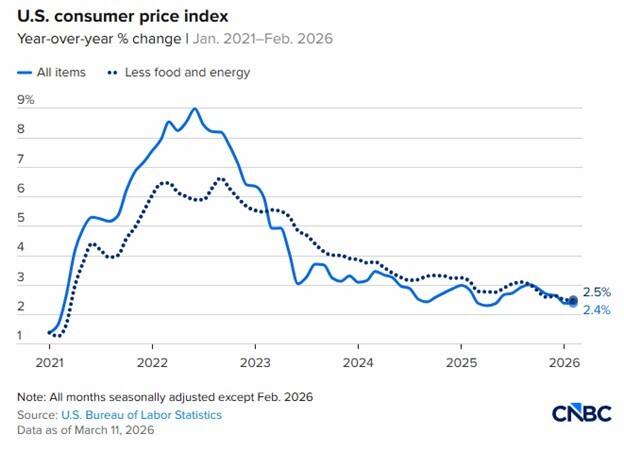
Prices consumers pay for a broad range of goods and services rose in line with expectations for February, offering a final look at inflation pressures before an oil shock tied to the Iran war rattled the outlook.
The consumer price index increased a seasonally adjusted 0.3% for the month, putting the 12-month inflation rate at 2.4%, according to Bureau of Labor Statistics data released Wednesday. Both numbers matched the Dow Jones consensus forecast.
Stripping out volatile food and energy prices, the core CPI posted a 0.2% monthly reading and 2.5% annual rate, compared with forecasts for 0.2% and 2.5%, also in line with the estimates.
The annual rates were unchanged from January, indicating that inflation was holding above the Federal Reserve’s 2% target but not getting worse. While the report showed inflation broadly stable, prices rose modestly for shelter and services while several goods categories, including used vehicles and auto insurance, saw declines.
“CPI inflation for February was along expectations but this is the calm before the storm that will show up due to surging gasoline prices in March,” said Sonu Varghese, chief macro strategist for the Carson Group. “Still, this report does show that the Fed has an inflation problem even if you set aside the energy shock. Tariff-impacts are still hitting core goods inflation, while services inflation outside housing remains hot.”
The data predates the recent surge in oil prices tied to the war with Iran, meaning any impact from higher energy costs will likely show up in the months ahead. The U.S.-Israel attack on Iran dramatically changed the outlook, at least in the near term. Following the assault, crude oil climbed sharply amid fears of supply disruptions in the Middle East.
Higher oil prices could complicate the inflation outlook in coming months, as increases in gasoline and other energy products often filter through to transportation, shipping and a wide range of consumer goods. Sustained gains in crude prices can quickly show up in headline inflation readings even if underlying price pressures remain stable.
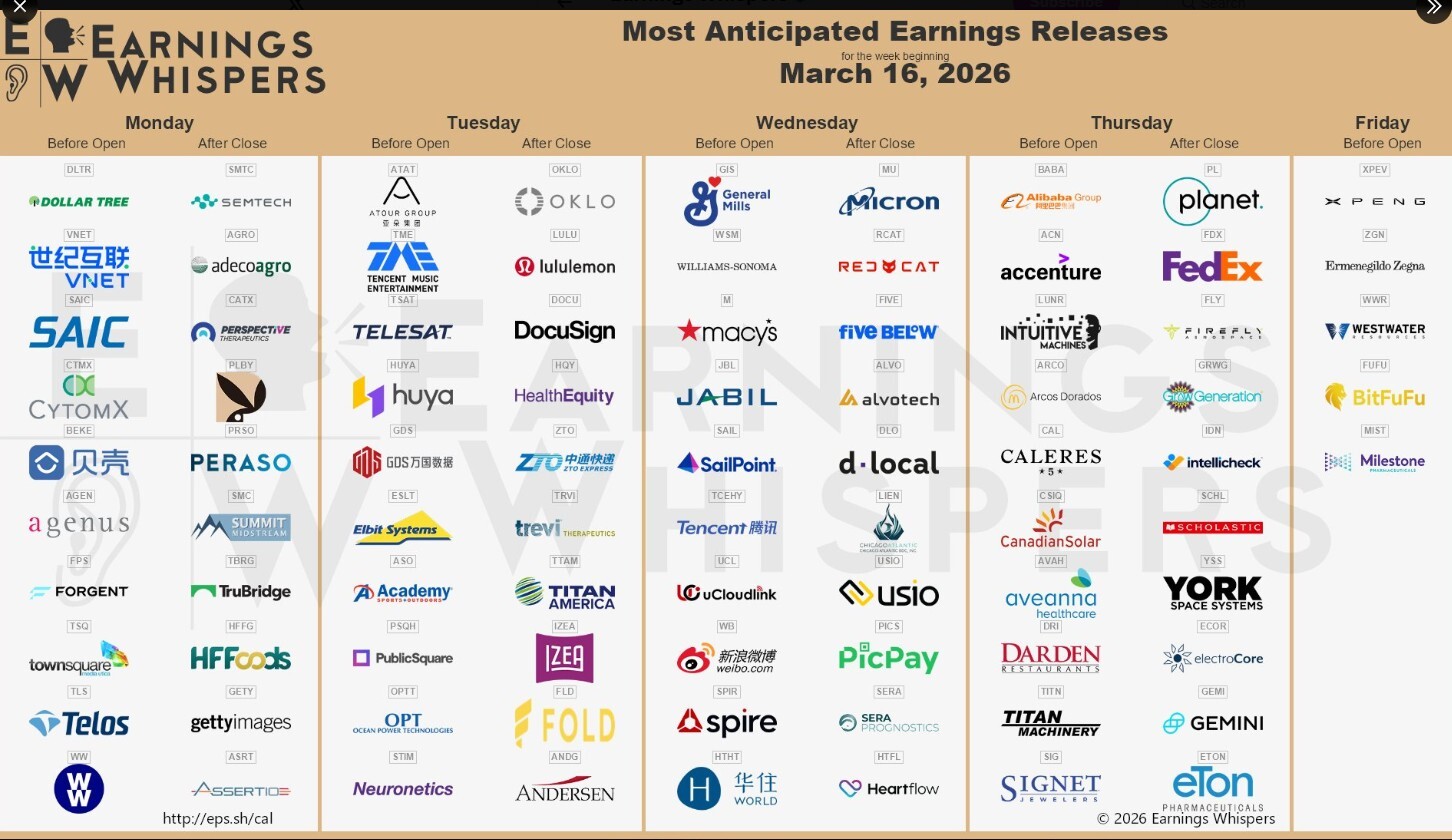
Economic Reports of Note (All Times EST):
Monday
8:30 am – CAN: CPI
9:15 am – US: Industrial & Manufacturing Production
9:15 am – US: Capacity Utilization
10:00 am – US: NAHB Housing Market Index
11:30 am – US: 3 & 6-month Bill Auctions
11:30 pm – AUS: RBA Interest Rate Decision
Tuesday
8:15 am – US: ADP Weekly Employment Change
8:55 am – US: Redbook
10:00 am – US: Pending Home Sales
11:30 am – US: 52-week Bill Auction
1:00 pm – US: 20-year Bond Auction
Wednesday
6:00 am – EUR: CPI
7:00 am – US: Mortgage Data
8:30 am – US: PPI
9:45 am – CAN: Bank of Canada Interest Rate Decision
10:00 am – US: Factory Orders & Durables
10:30 am – US: Crude Oil Inventories
2:00 pm – US: Fed Interest Rate Decision
2:30 pm – US: FOMC Press Conference
10:30 pm – JAP: Bank of Japan Interest Rate Decision
Thursday
8:00 am – GBP: Bank of England Interest Rate Decision
8:00 am – US: Buiilding Permits
8:30 am – US: Philadelphia Fed Manufacturing Index
8:30 am – US: Weekly Jobless Claims
9:15 am – EUR: ECB Interest Rate Decision
10:00 am – US: New Home Sales
10:00 am – US: Wholesale Inventories
11:30 am – US: 4 & 8-week Bill Auctions
Friday
N/A