
This week, Nvidia (NVDA) and tech positivity sustained market gains despite losses on Friday after Federal Reserve Chairman Kevin Warsh spoke and September interest rate-hike odds nearly doubled.
INFLATION EXPECTATIONS MUST BE ‘CLOSELY MINDED’
It was his comments on inflation that arguably went the furthest to meet what some had seen as a gap in Warsh’s remarks at his first two press conferences. (More on that below).
Oil prices fell nearly 4% for the week, to roughly $83.50 per barrel. Energy market news was dwarfed by other headlines, even as Venezuela, with its massive, untapped oil reserves and U.S.-friendly regime, considers an OPEC exit, according to a Wednesday Bloomberg report. Venezuela was among the five founding members of the Organization of Petroleum Exporting Countries in September 1960, along with Iran, Iraq, Kuwait, and Saudi Arabia.
Ahead of this week’s August non-farm payrolls report, we learned of the preliminary annual benchmark revision estimate to the payrolls data on Friday. The number was an adjusted -79,000 and the Bureau of Labor Statistics will issue a final benchmark revision in February. The benchmark revisions have been abnormally large since the pandemic due to measurement model challenges and low survey response rates.
For the week, the DOW gained +0.5% to 53,560, the S&P 500 also added +0.5% to 7,712, the Nasdaq rallied by +0.9% to 26,402 and the Russell 2000 declined -1.5% to 2,972. The CBOE VIX lost -4.6% to 14.43.

Right From the Horses Mouth
Kevin Warsh passed another big test as new Federal Reserve chairman on Friday: He said the central bank will “have more work to do” on inflation, and the bond market took him at his word.
But here’s the issue: Inflation hasn’t been the thing driving a sharp selloff in long-term government debt lately, so Warsh may have just won a fight that the Treasury market wasn’t really having in the first place.
It was his comments on inflation that arguably went the furthest to meet what some had seen as a gap in Warsh’s remarks at his first two press conferences.
In his first speech at the annual Jackson Hole Economic Policy Symposium on Friday, the new Fed chair said that high levels of inflation in recent months remain concerning. Warsh added that he would be “hard-pressed” to describe broad financial conditions as restrictive — meaning interest rates weren’t high enough to slow economic growth.
With the labor market stable, inflation too high, and little in financial conditions to indicate that the Fed’s policy rate is restraining it, he said, “The Fed’s predominant focus right now should be on prices.” The remarks drew applause from an audience of global central bankers hungry for more than his previous vague promises to deliver price stability, and unsettled by his refusal to say how he would do so. Markets heard the change in tune, and moved to increase bets on a rate hike next month even as they still priced in a healthy dose of skepticism that he will deliver it.
He did not directly address recent market interventions by U.S. Treasury Secretary Scott Bessent, which have put downward pressure on long-term Treasury yields. But he did say the Fed “needs clear market signals, as unfiltered as possible” to set proper monetary policy.

Increasing Odds
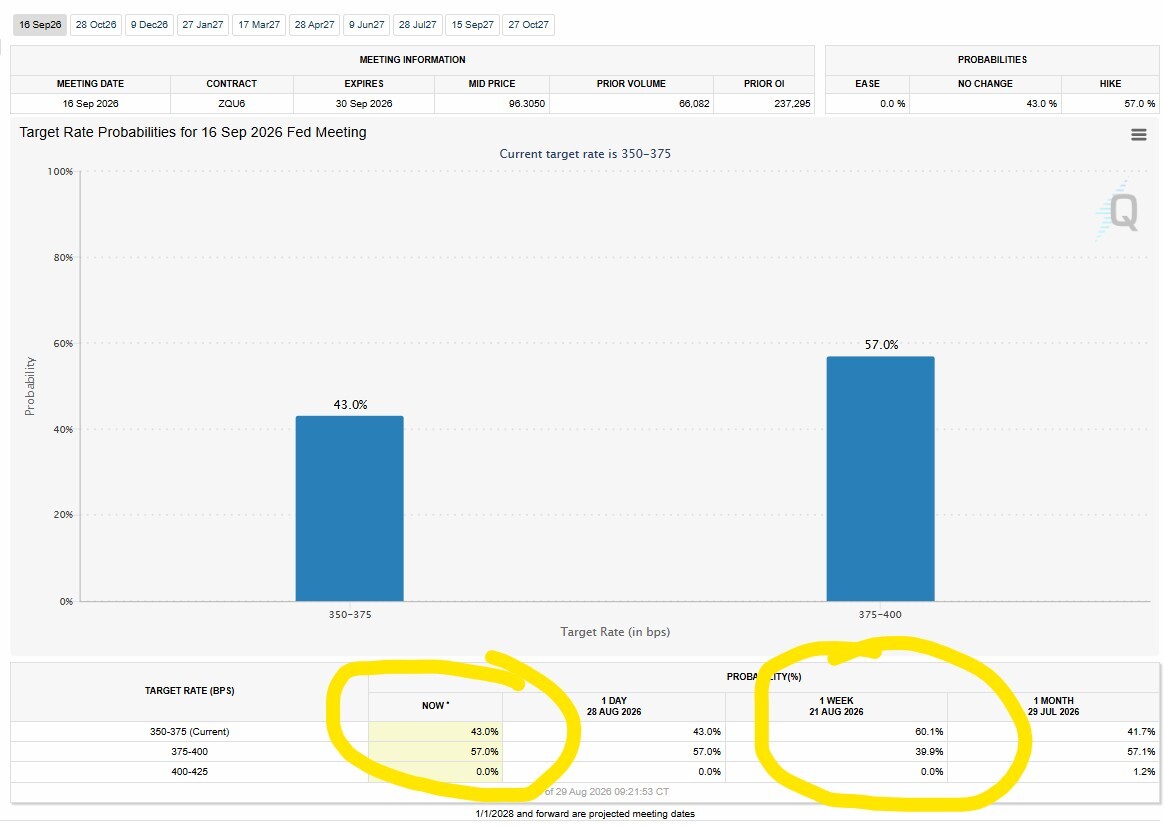
After Warsh spoke, the CME Group FedWatch tool put the probability near 60% that the Federal Open Market Committee could raise rates September 16-17, which was a spike from the 35% chance indicated pre-market Friday.
Thirty-day fed funds futures prices now suggest a 57.5% chance the Federal Reserve will raise benchmark lending rates quarter percentage point from their current range of 3.50% to 3.75%.
On Thursday, a day before Fed Chairman Kevin Warsh’s policy address at the central bank’s annual symposium Friday in Jackson Hole, Wyoming, odds of a rate increase next month stood at closer to a third, or 35.4%.
The current odds are even higher than they were a month ago, when chances policy would be tightened stood at 55.8%.
NVDA Resets the Narrative
Nvidia’s (NVDA) earnings report was originally greeted with a bit of a yawn. Then, during the conference call, management indicated that revenues are likely to grow by 70%, well above the 45% analyst consensus. Suddenly, the AI trade seemed much sunnier.
Although the original earnings release contained the now-customary surpassing of analysts’ expectations, the stock initially traded lower. Had it continued with the early modest declines, today would have been the fifth quarter in a row where NVDA closed lower despite a solid report. It is not clear why the company decided to wait until the start of the conference call to reveal the substantial increase in revenue guidance.
Perhaps its executives felt that it would maximize the positive impact on the stock price. By waiting, they forced the early sellers to reverse course, thus providing an extra catalyst to the price bump that followed.
A revenue increase of that magnitude is remarkable, especially when starting from an already enormous base. Whether you think of NVDA as the linchpin of the AI industry, the central banker for that industry, or the nexus of a series of self-dealing, interlocking deals that artificially prop up the industry’s numbers, what’s good for NVDA is good for AI, and thus good for major indices. For now, the simplest factor is the dominant one: if the biggest, most important company in the AI industry is thriving, and seemingly constrained only by external capacity issues rather than demand, that bodes well for the broader trade.
In recent months, we have seen many companies, particularly in the tech sector, fail to rally after reporting good results. My theory is that many, if not most, institutional investors were already fully invested in those popular names. Good results reaffirmed their investment theses but were often insufficient to incentivize them to add to already market-weight or overweight allocations. Hence, the relative lack of reaction, akin to the slight declines that occurred after NVDA’s prior four reports. But if institutions are relatively underweighted in stocks that report good news, the fund managers rush into them en masse.
Economic Reports of Note (All Times EST):
Monday
9:45 am – US: Chicago PMI
10:30 am – US: Dallas Fed Mfg Business Index
11:30 am – US: 3 & 6-month Bill Auction
11:35 pm – JAP: 10-year JGB Auction
Tuesday
5:00 am – EU: CPI
8:55 am – US: Redbook
9:05 am – US: Fed Vice Chair Barr Speaks
9:45 am – US: S&P Global Manufacturing PMI
10:00 am – US: JOLTS
10:00 am – US: ISM Manufacturing PMI
10:00 am – US: Construction Spending
10:30 am – US: Dallas Fed Services Revenues
11:30 am – US: Atlanta Fed GDPNow
11:30 am – US: 52-week Bill Auction
10:00 pm – AU: Royal Bank of Australia Interest Rate Decision
11:00 pm – NZ: Royal Bank of New Zealand Interest Rate Decision
Wednesday
7:00 am – US: Mortgage Data
8:15 am – US: ADP Nonfarm Employment Change
9:45 am – CAN: Bank of Canada Interest Rate Decision
10:00 am – US: Factory Orders
10:00 am – US: Durable Goods
10:30 am – US: Crude Oil Inventories
2:00 pm – US: Beige Book
11:35 pm – JAP: 30-year JGB Auction
Thursday
5:00 am – EU: PPI
5:30 am – US: Challenger Job Cuts
8:30 am – US: Weekly Jobless Claims
8:30 am – US: Trade Balance
8:30 am – US: Fed Member Waller Speaks
9:45 am – US: S&P Global Composite & Services PMI
10:00 am – US: ISM Non-Manufacturing PMI
11:30 am – US: Atlanta Fed GDPNow
11:30 am – US: 4 & 8-Week Bill Auctions
Friday
7:30 am – US: August Nonfarm Payrolls