
Stocks posted a second straight week of gain and the S&P 500 closed above 7,700 for the first time ever earlier this week. The Nasdaq gained over 5% thanks to a bounce-back in chip stocks as the iShares Semiconductor ETF (SOXX) rallied more than 7% this week. The Dow, also had a nice run as all three indexes notched their best weekly performances since April.
The strong week of gains came after data showed the U.S. economy unexpectedly shed jobs last month and dampened expectations the Federal Reserve would raise interest rates at its September meeting. The Labor Department said nonfarm payrolls decreased by 23,000 jobs last month, well below the estimate of economists polled by Reuters that called for an increase of 80,000 jobs. Previously reported job gains for the prior two months were also revised sharply lower, while the unemployment rate fell to 4.1% last month from 4.2% in June due to workers leaving the labor force (more on that below).
Market expectations for a rate hike from the Fed at its next meeting dropped to about 44%, according to the CME FedWatch, down from 55% the day before and 67% a week ago.
Signs of progress for a potential peace deal in the Iran war have helped cool oil prices and, in turn, have eased inflation worries that could prompt a Fed rate hike. It also helped push Treasury yields lower.
A strong earnings season has also tempered concerns about the massive spending by AI-related companies, sending each of the three major indexes to their biggest weekly percentage gains since mid-April.
For the week, the DOW gained +3.0% to 54,037, the S&P 500 added +3.6% to 7,758, the Nasdaq soared +5.2% to 26,691 and the Russell 2000 closed higher by 3.5% to 3,034. The CBOE VIX decreased by -6.8% to 14.9.

Negative 23?
The U.S. economy unexpectedly shed jobs in July and nonfarm payrolls for the prior two months were revised sharply lower, raising questions about whether the Federal Reserve will increase interest rates next month.
Nonfarm payrolls decreased 23,000 last month following a combined 103,000 downward revision to the May and June figures, Bureau of Labor Statistics data showed Friday. The unemployment rate fell to 4.1% as labor force participation continued to slide, and wage growth slowed. The unemployment rate fell because another 264,000 people left the labor force, pushing the participation rate to 61.4%, the lowest since the 1970’s excluging the pandemic.
The report suggests the labor market may be starting to falter amid rising prices and uncertainty from the Iran war, despite recent data showing strength in consumer spending and business investment.
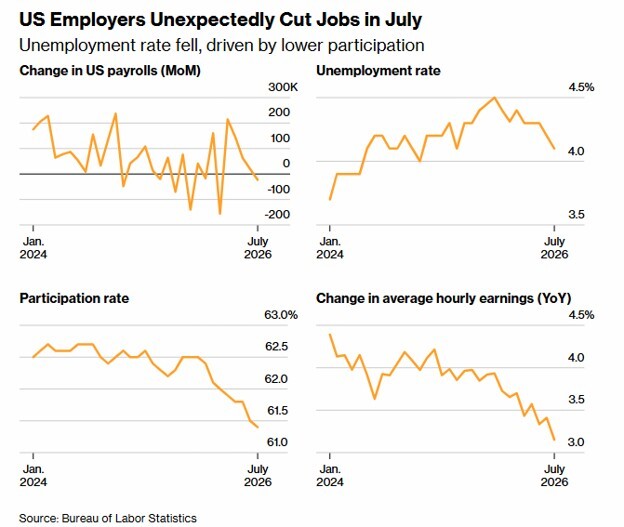
Going into Friday’s data release, the consensus was that the labor market was stable and had gained ground since last year’s stalled-out environment. Though job growth has a tendency to slow during summer, the decline in payrolls and sharp downward revisions to May and June data could challenge the narrative of a “slow hire, slow fire” labor market.
Payrolls last month were weighed down by a 50,000 decline in local government education employment. The retail trade sector lost 19,000 jobs, the bulk of them at warehouse clubs, supercenters and other general merchandise stores. Employment in financial activities fell further, shedding 14,000 jobs. Financial activities jobs are down by 121,000 since peaking in May 2025.
Healthcare payrolls increased 22,000, but well below the monthly average of 36,000 over the past year. Employment was little changed in the construction and manufacturing sectors.
With July’s job loss and the softer growth in May and June, monthly payroll growth averaged just 34,000 over the last 12 months, the BLS reported Friday. That paints a much weaker picture of the labor conditions and casts serious doubt on the possibility of the Fed raising interest rates.

So what The Economist’s Big Mac Index demonstrates right now, in the most general terms, is that Asian currencies are cheap The release of CPI and PPI data is always a huge deal and typically can be a market moving event. But this Wednesday’s report may hold signficantly more weight in both the direction of the market and interest rates.
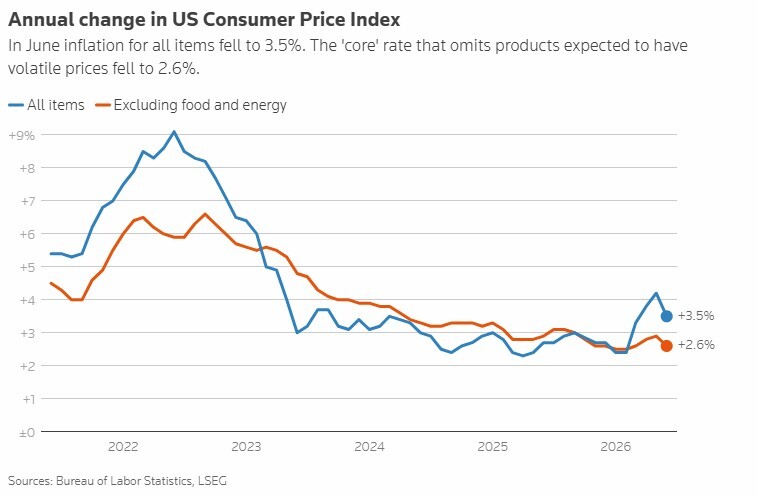
The July CPI report comes on the heels of a Fed meeting that revealed divisions about how the central bank should handle inflation that has run above its 2% annual target for several years.
Economists polled by Reuters expect CPI to rise 3.4% on a year-over-year basis. A 2.5% annual rise is projected for core CPI, which excludes the volatile food and energy components.
CPI has been coming down the last couple of months and coupled with the horrific jobs report may be enough to prevent the Fed from hiking rates this year. However, if CPI snaps back higher and comes in above forecast on Wednesday, the market may not react so nicely.
The monthly report on producer prices, due a day after CPI, will also flesh out the inflation picture. Retail sales data on Friday offers a view into consumer spending, which is a key gauge for the strength of the broader economy.
At this late stage of the Q2 earnings season, the S&P 500 is reporting impressive results, even if one excludes the unusually large EPS surprises reported by Alphabet and Amazon.com. Overall, both the percentage of S&P 500 companies reporting positive earnings surprises and the magnitude of earnings surprises are above recent averages. As a result, the index is reporting higher earnings for the second quarter today relative to the end of last week and relative to the end of the quarter. In addition, the index is also reporting its highest (year-over-year) earnings growth rate since Q2 2021.
Overall, 88% of the companies in the S&P 500 have reported actual results for Q2 2026 to date. Of these companies, 86% have reported actual EPS above estimates, which is above the 5-year average of 78% and above the 10-year average of 76%. If 86% is the actual number for the quarter, it will mark the highest percentage of S&P 500 companies reporting a positive EPS surprise since Q2 2021 (87%).
Economic Reports of Note (All Times EST):
Monday
10:00 am – US: Conference Board Employment Trends Index
11:30 am – US: 3 & 6-month Bill Auction
11:30 pm – AUS: Royal Bank of Australia Interest Rate Decision
Tuesday
8:55 am – US: Redbook
10:00 am – US: Existing Home Sales
1:00 pm – US: 3-Year Note Auction
Wednesday
6:00 am – US: OPEC Monthly Report
7:00 am – US: Mortgage Data
8:30 am – US: CPI
8:30 am – US: Real Earnings
10:30 am – US: Crude Oil Inventories
11:00 am – Cleveland CPI
1:00 pm – US: 10-year Note Auction
2:00 pm – US: Federal Budget Balance
Thursday
2:00 am – UK: GDP
8:30 am – US: PPI
8:30 am – US: Weekly Jobless Claims
8:40 am – US: FOMC Member Barkin Speaks
11:30 am – US: 4 & 8-Week Bill Auctions
1:00 pm – US: 30-year Bond Auction
Friday
5:00 am – EU: GDP
8:30 am – US: Retail Sales
10:00 am – US: Michigan Inflation Expectations
10:00 am – US: Michigan Consumer Sentiment
10:00 am – US: Business Inventories
11:30 am – US: Atlanta Fed GDPNow