
Wall Street’s major averages declined this week after a continuous sell-off in semiconductor stocks rattled the markets, while tensions in the Middle East persisted.
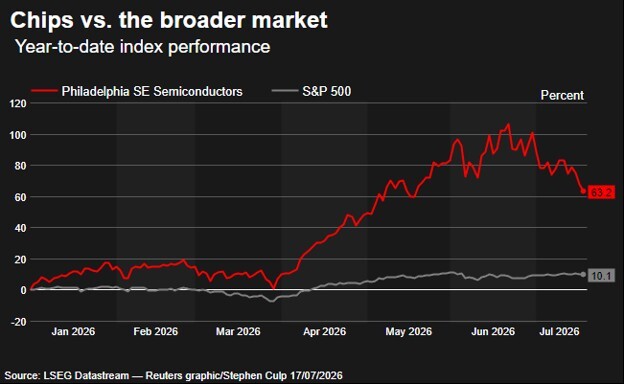
A rotation from semiconductor investments was a big theme of the week that was, with real estate and energy sectors in the S&P 500 advancing while communication services, utilities, and information technology moved lower. For the week, the PHLX Semiconductor Index (SOX) tumbled more than 5%, continuing a selloff from its all-time high on June 22.
With the U.S. military strikes escalating in Iran, crude oil futures moved higher to settle up 4.5% on the week to $81.52 per barrel.
On the economic front, consumer sentiment increased to a five month high in July, but single-family housing starts and building permits dipped, and industrial output increased by a meager 0.1%.
Increasing expectations for profit strength this year have provided solid support for investors’ enthusiasm for stocks. Now they are counting on second quarter earnings season, just under way, to show the corporate profit engine is still humming along, with S&P 500 earnings projected up a whopping 26% in the period, according to LSEG IBES data.
For the week, the DOW lost -0.9% to 52,146, the S&P 500 declined -1.6% to 7,458, the Nasdaq slumped by -2.9% to 25,520 and the Russell 2000 declined by -0.5% to 2,962. The CBOE VIX soared +24.9% to 18.77.
Semiconductor Stocks’ Worst Slump in Over a Year —Are Chips Now Cheap Enough?
For the first time since late April, semiconductors no longer carry a valuation premium over the broader Nasdaq. The sector that doubled off its February low is now priced like the average large-cap tech stock.
The Philadelphia Semiconductor Index – as tracked by the iShares Semiconductor ETF – has fallen 13.2% over the past four weeks. That is the sharpest four-week move for the fund since April 2025. Measured from the late-June peak, the drawdown is closer to 15%.
The slide follows an extraordinary run. From its February low, SOXX gained 102.6% into the late-June high. The fund is still up 84.6% year-to-date, against 17.1% for the Invesco QQQ Trust.
Why SOXX Sold Off – Three forces drove the reversal.
The first is growing uncertainty around AI capital spending — the money hyperscalers commit to building data centers, which has been the single largest source of chip demand for two years. Investors have started questioning how long that spending stays at current levels.
The second is rising competition from China. Chinese memory maker CXMT filed to raise close to $10 billion in a Shanghai initial public offering, a signal that supply in the memory market may be about to expand. Memory-related names led the group lower.
Layered on top of both: profit-taking after several names inside the sector went parabolic.
Are Chips Cheap Now?
The forward price-to-earnings ratio — what investors pay today for each dollar of profit a company is expected to earn over the next year — has fallen to 24.7 times for SOXX. That is roughly in line with its three-year average. More importantly, it is now level with the Nasdaq 100 at 24.0 times.
That convergence matters.
Since late April, semiconductors traded at a clear premium to the broader index, peaking above 32 times in late June. That premium is gone. Investors are no longer paying extra for chip earnings relative to big tech earnings.
A second valuation gauge tells an even sharper story. The PEG ratio — the price-to-earnings ratio divided by the expected growth rate, which asks how much you are paying for each unit of growth — sits at 1.26x for SOXX. That is the lowest reading since 2016.
The QQQ PEG is 1.56x.
But that doesn’t mean that the chip era is over.
“Investors seem to want clarity on whether higher AI spending reflects rising costs or stronger demand,” writes Joe Mazzola, head trading & derivatives strategist at Charles Schwab.
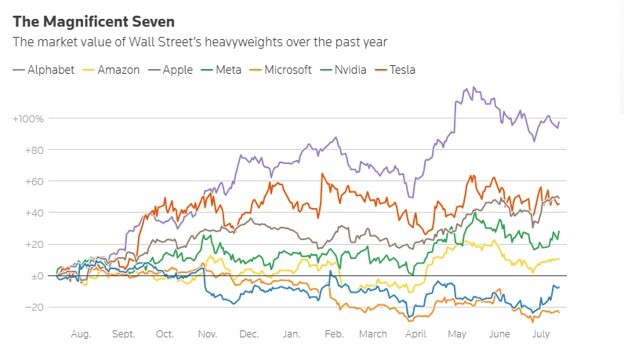
“Wherever things head in coming days, recent chip volatility appears to be more of a valuation and positioning reset than the end of the AI infrastructure cycle. The next hurdle for chips is earnings from so-called ‘hyperscaler’ chip buyers, starting with Alphabet this week.”
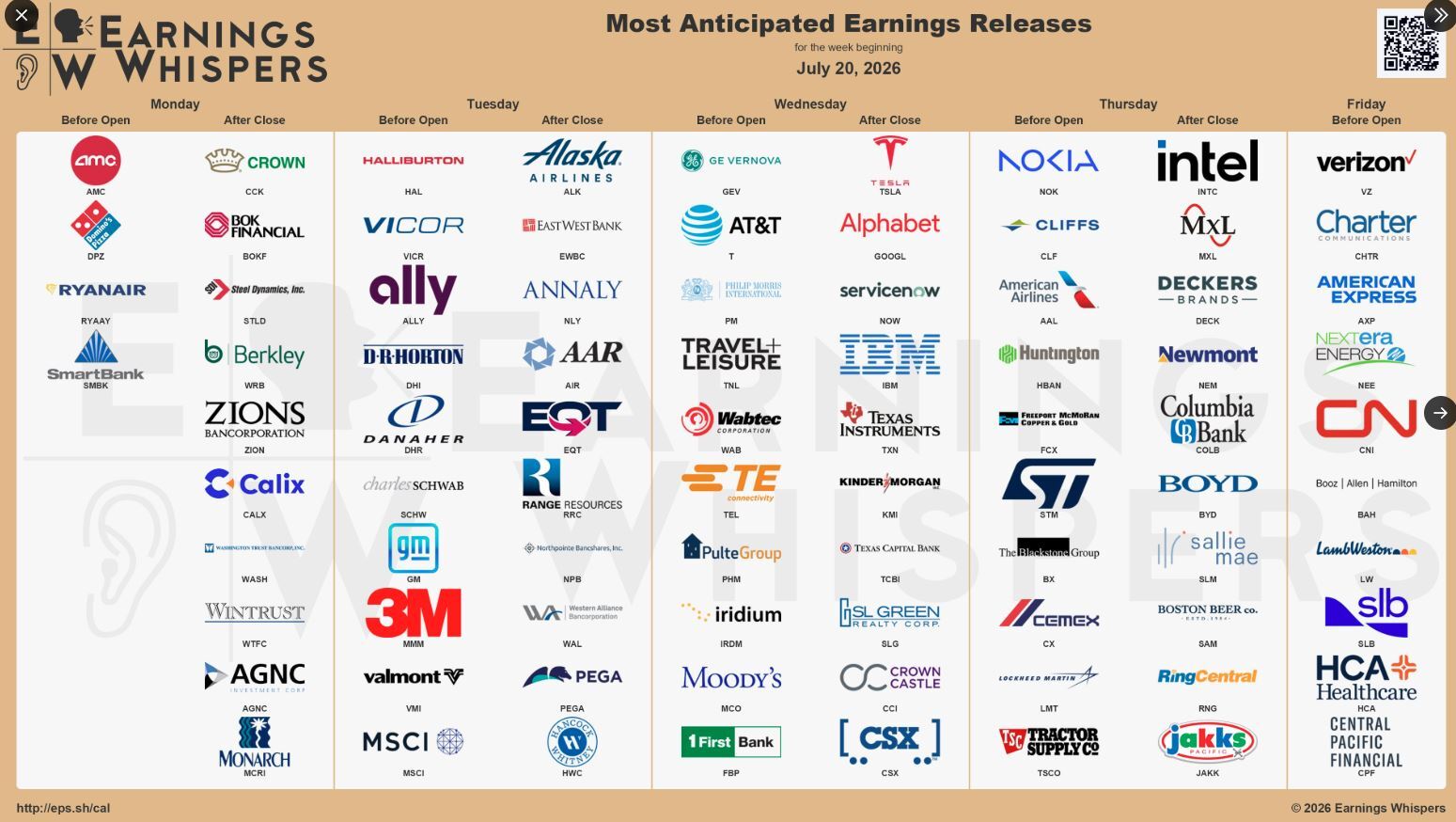
Heavy Earnings Week
At this early stage, the second quarter earnings season for the S&P 500 is off to a strong start relative to expectations. Both the percentage of S&P 500 companies reporting positive earnings surprises and the magnitude of earnings surprises are above recent averages. As a result, the index is reporting higher earnings for the second quarter today relative to the end of last week and relative to the end of the quarter. The index is also reporting (year-over-year) earnings growth above 20% for the 2nd straight quarter.
This is a crucial week for the markets as earnings season ramps up. Investors also look to the Farnborough International Airshow for aerospace orders and AMD’s latest artificial intelligence announcements.
Wednesday features a particularly full plate with Alphabet (GOOGL), Tesla (TSLA), Texas Instruments (TXN), GE Vernova (GEV), and Philip Morris (PM). IBM (IBM) pre-announced an earnings miss last week, which sent the stock down more than 25% ahead of its formal Wednesday report.
Thursday’s standout name is Intel (INTC). .
Overall, 10% of the companies in the S&P 500 have reported actual results for Q2 2026 to date. Of these companies, 88% have reported actual EPS above estimates, which is above the 5-year average of 78% and above the 10-year average of 76%.
In aggregate, companies are reporting earnings that are 16.4% above estimates, which is above the 5-year average of 7.0% and above the 10-year average of 7.4%. Historical averages reflect actual results from all 500 companies, not the actual results from the percentage of companies that have reported through this point in time.
Economic Reports of Note (All Times EST):
Monday
8:30 am – CAN: CPI
9:400am – US: Leading Index
11:30 am – US: 3 & 6-month Bill Auctions
Tuesday
8:15 am – US: ADP Employment Change
8:55 am – US: Redbook
Wednesday
2:00 am – UK: CPI & PPI
7:00 am – US: Mortgage Data
10:30 am – US: Crude Oil Inventories
1:00 pm – US: 20-year Bond Auction
Thursday
8:15 am – EU: ECB Interest Rate Decision
8:30 am – US: Weekly Jobless Claims
8:30 am – US: Chicago Fed National Activity
11:00 am – US: KC Fed Composite & Manufacturing Index
11:30 am – US: 4 & 8-Week Bill Auctions
1:00 pm – US: 10-year TIPS Auction
Friday
8:00 am – US: Building Permits
9:45 am – US: S&P Global Composite, Manufacturing & Services PMI
10:00 am – US: New Home Sales